Ottawa joins a $103 billion Ukraine support loan and deepens cooperation with Brussels on critical minerals, artificial intelligence and digital trade in a bid to strengthen economic and strategic independence.
The European Union and Canada have agreed to deepen their strategic partnership, announcing a series of initiatives on trade, technology and security as US President Donald Trump’s policies strain Washington’s relations with traditional allies.
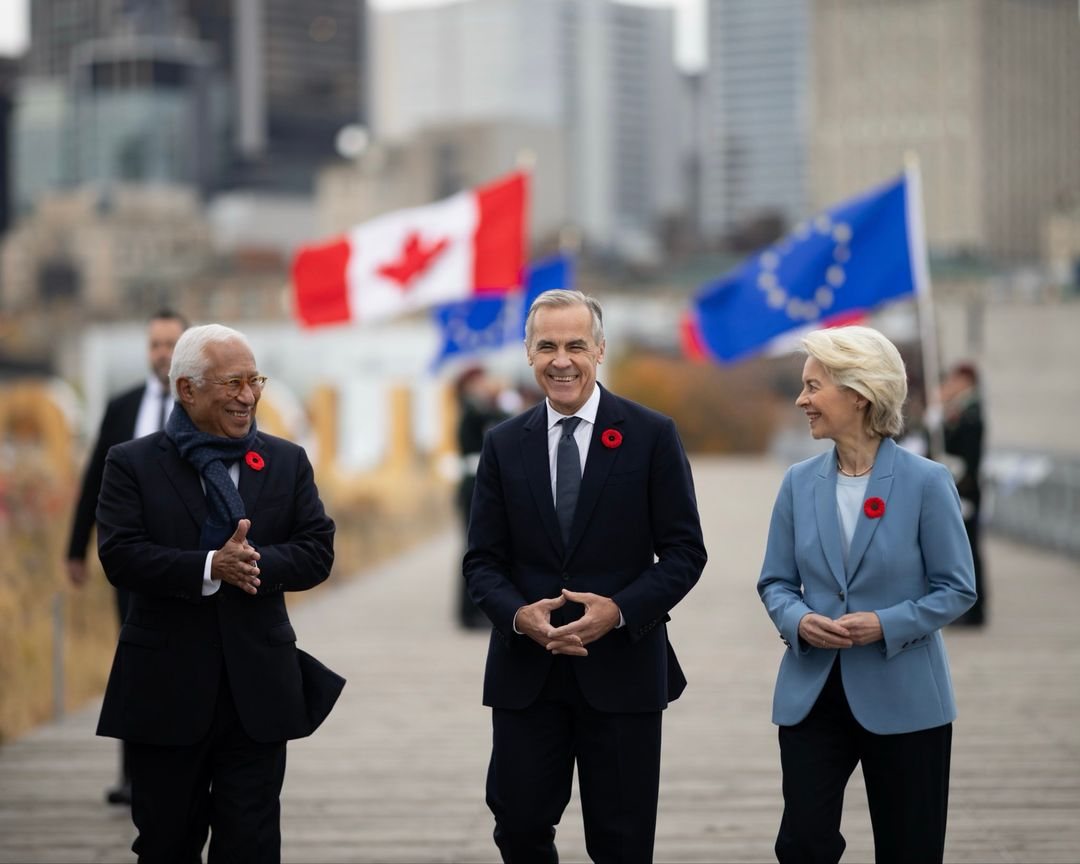
The agreement was announced on Friday following a two-day summit in Montreal attended by Canadian Prime Minister Mark Carney, European Commission President Ursula von der Leyen and European Council President Antonio Costa.
Canada will join the EU’s $103 billion (€90 billion) support loan for Ukraine, initially contributing $558 million (€500 million), while the two sides will expand cooperation across several strategic sectors.
“The world’s becoming more dangerous and divided. Our societies are being shaken by new storms,” Carney told reporters, pointing to eroding democratic norms and the “weaponization of trade”.
“Together, Canada and the European Union are anchoring the ground. Anchoring our ground to uphold our values while forming a protective canopy under which our citizens can all thrive,” he said.
Canada joins EU’s Ukraine support effort
Canada’s participation in the $103 billion loan comes as Brussels seeks additional support to address Ukraine’s financial needs amid its ongoing war with Russia.
Von der Leyen welcomed Ottawa’s contribution, saying the move sent a strong message of solidarity to Kiev.
“Together, we are stepping up our support for Ukraine,” she said.
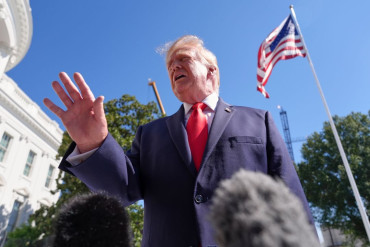
The announcement also reflects broader efforts by Canada and the EU to strengthen ties following Trump’s return to the White House. Both have faced US tariffs and territorial rhetoric, prompting renewed discussions about reducing economic vulnerabilities and reinforcing cooperation among traditional partners.
Although Von der Leyen said Canada could not become a full EU member because of its geographical location, she stressed that the bloc wanted to bring the country “as close as possible”.
Critical minerals and AI at heart of economic partnership
Beyond Ukraine, the two sides outlined what a joint statement described as an “alliance for the future” aimed at building a shared space for prosperity and economic security.
They signed a digital trade agreement and a separate arrangement allowing the European Investment Bank to support Canadian critical mineral projects.
Canada has substantial reserves of rare earths and other critical minerals that Europe needs to diversify its supply chains, which currently depend heavily on China. However, developing Canada's mining sector will require significant investment in infrastructure.
The EU also opened access to its supercomputing infrastructure for Canadian researchers, businesses and start-ups, while the partners agreed to deepen cooperation on artificial intelligence, satellite connectivity and navigation.
The technology partnership comes as Europe and Canada seek to strengthen their positions in industries dominated by the United States and China.
On Thursday, Ottawa announced a $1.1 billion (CAN1.6 billion) investment in Canadian AI company Cohere. The firm recently partnered with Germany’s Aleph Alpha, a collaboration Carney cited as an example of the potential for closer transatlantic technology cooperation.
Cooperation extends to education and satellite navigation
The EU and Canada also launched work towards Canadian participation in European initiatives, including the Erasmus student exchange programme and the Galileo satellite navigation system.
Erasmus enables university students to study abroad, while Galileo provides a European alternative to the US-operated Global Positioning System (GPS).
The initiatives underline the expanding scope of the partnership, which now extends beyond traditional trade and diplomacy into technology, education, infrastructure and strategic security.
TRT World and Agencies — TRT World and Agencies