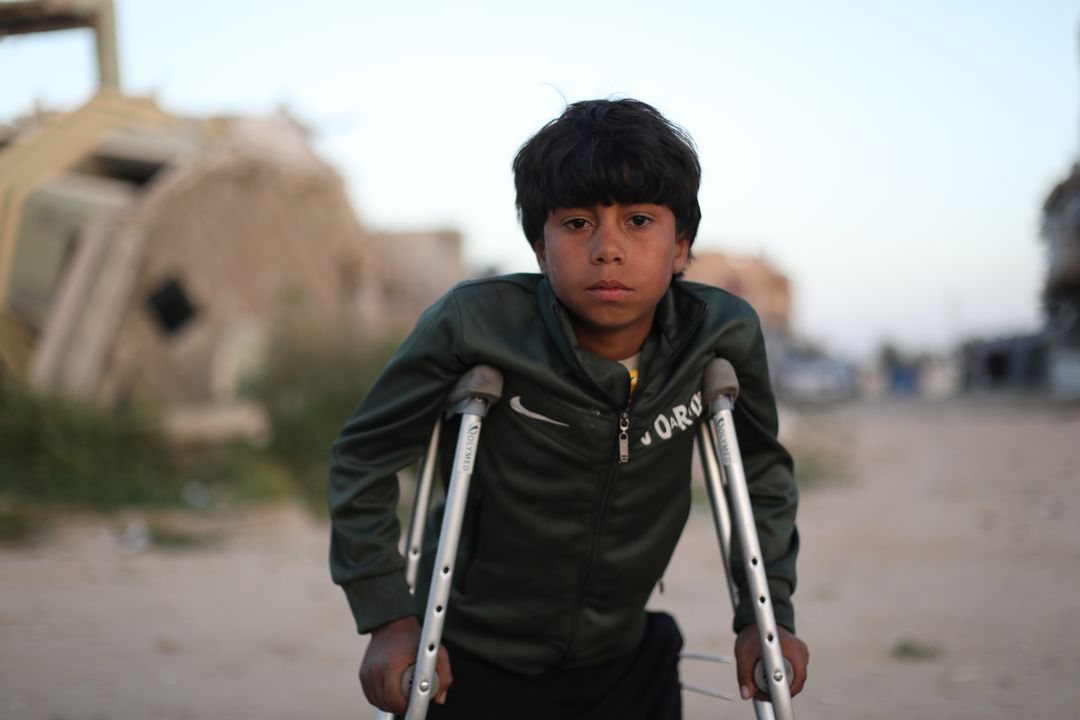
Palestinian children were deliberately targeted, a UN commission finds, extending its age-based persecution finding to the occupied West Bank.
The deliberate killing and injuring of Palestinian children in Gaza and the occupied West Bank by Israeli forces amounts to age-based persecution, a United Nations commission of inquiry has found.
In a report presented on Monday to the UN General Assembly, the Independent International Commission of Inquiry on the Occupied Palestinian Territory, including East Jerusalem, and Israel concluded that Israeli forces had persecuted Palestinian children on the basis of age in the occupied West Bank, extending its earlier finding on Gaza.
The commission said the repeated attacks and severe physical and psychological harm inflicted on children were part of a broader pattern of intentional violence.
Persecution as a crime against humanity entails a severe deprivation of fundamental rights on discriminatory grounds, according to Nasir Qadri, an international law practitioner and critical legal scholar at Koc University.
“Age-based persecution applies that discriminatory ground specifically to children as a group. In this context, their age was the basis for the use of lethal and injurious force against them, rather than children simply being part of the population caught up in a military campaign,” Qadri tells TRT World.
“War crimes require proof of specific prohibited acts, while genocide requires proof of the intent to destroy a group as such,” he adds.
“Persecution falls into a different legal category. It requires a widespread or systematic attack, a severe deprivation of rights, and discriminatory intent directed at the group being targeted.”
“The Commission found all three, with age as the discriminatory ground, across the occupied Palestinian territory as a whole. The West Bank finding extends a conclusion previously confined to Gaza. Age-based persecution is now the Commission’s determination for both,” he says.
The commission investigated seven cases involving killings and serious harm to Palestinians in the occupied West Bank between November 2023 and June 2026, and documented six.
In most cases, the victims were children, including an infant. The commission found that they were unarmed, posed no imminent threat, and were targeted without warning, often in the head or upper body.
It concluded that Israeli soldiers intentionally killed the victims, despite being in a position to recognise that they posed no immediate danger.
In one case, an Israeli soldier fired on a car carrying a Palestinian family in Hebron on June 5, 2026, killing a seven-month-old baby with a shot to the head and injuring both parents.
Video footage showed the father slowing down, stopping the car and raising his hands as he approached the soldiers.
The Israeli army said the soldier had fired because the vehicle was accelerating towards them, but the commission found that the soldier had a clear, unobstructed view of the occupants from a distance of about 10 metres. The family received no medical assistance.
In another incident, a 14-year-old Palestinian boy was shot in the chest and killed near the entrance to Jenin refugee camp on September 8, 2025.
Israeli forces had closed the camp in January, displacing its residents.
When rumours spread that troops might be withdrawing, around 50 to 60 residents went back to check on their homes. Israeli forces arrived by vehicle and opened fire without warning, killing the boy.
What is age-based persecution?
Persecution is a crime against humanity under international criminal law. It involves the intentional, severe deprivation of fundamental rights because of a person’s identity or membership in a particular group, with discriminatory intent.
Age-based persecution applies this legal framework to harm inflicted on people because of their age.
Not every killing or injury of a child automatically amounts to persecution. The legal determination depends on the severity of the harm, evidence of discriminatory intent, and the broader context in which the acts took place.
In the case of Palestinian children, the commission concluded that the attacks’ recurrence and widespread nature revealed a pattern of intentional violence, rather than children merely being caught up in military operations.
The legal finding depends on the nature and severity of the harm, evidence of discriminatory intent and the wider context in which the acts took place.
The report also found that Palestinians in the occupied West Bank were being targeted on the basis of their nationality, race, ethnicity, gender and age.
Qadri points to the International Criminal Tribunal for the former Yugoslavia's (ICTY) Kupreskic case, which examined the persecution and killing of Bosnian Muslim civilians during the 1993 attack on Ahmici, Bosnia and Herzegovina.
“In the Kupreskic case, the ICTY established that discriminatory intent can be demonstrated through the cumulative effect of acts that may appear ambiguous when viewed individually, but which reveal a pattern when considered alongside an established policy,” Qadri says.
In other words, discriminatory intent need not be established by any single incident if the evidence as a whole demonstrates a pattern.
“The Commission found that Israeli forces applied permissive rules of engagement exclusively against Palestinians, concentrating lethal force on children approaching designated lines, as part of a coordinated attack across the occupied Palestinian territory,” Qadri adds.
A wider pattern of violence
The report describes a sharp deterioration in the human rights situation in the occupied West Bank since October 7, 2023, as Israeli forces' attacks and sustained settler violence have increasingly endangered Palestinian civilians.
The scale of lethal force has changed dramatically. According to the commission, six Palestinians were killed by air strikes in the occupied West Bank between 2008 and October 6, 2023.
Between October 7, 2023, and September 30, 2026, air strikes killed 254 Palestinians.
The commission concluded that Israeli military operations and settler violence were part of a widespread, systematic attack on Palestinian civilians in the occupied West Bank.
It also linked the violence to territorial expansion and displacement.
Israeli military operations since January 2025 have led to the largest displacement of Palestinians in the occupied West Bank since 1967, with 34,176 people still displaced as of August 2026, according to the report.
The findings add to a growing body of evidence concerning alleged and established violations of international law against Palestinians. But documenting crimes and securing accountability remain separate challenges.
“The ICC Pre-Trial Chamber’s arrest warrants for Netanyahu and Gallant mean that the situation in Gaza is already part of active proceedings. The Commission’s finding of age-based persecution could also provide evidentiary material for the Office of the Prosecutor as it builds its case,” Qadri says.
“The ICJ is continuing to hear South Africa’s case under the Genocide Convention, and the Commission’s findings on the West Bank add to the factual record the Court can consider when assessing Israel’s compliance with its January 2024 provisional measures order.”
“So the legal avenues are already open and active. The main obstacle is not jurisdiction, but enforcement,” Qadri adds.
Accountability efforts
The commission's conclusions go beyond documenting individual abuses.
By classifying the deliberate killing of Palestinian children and the serious physical and psychological harm inflicted on them as age-based persecution, the commission has identified this conduct in both Gaza and the occupied West Bank as a crime against humanity.
The report also found that Israeli authorities and forces continued to commit genocidal acts in Gaza after the October 2025 ceasefire, with the intent to destroy Palestinians, in whole or in part.
In the occupied West Bank, it documented other crimes against humanity, including extermination, torture, rape, and other forms of sexual violence.
The commission called on Israel to end its unlawful occupation of Palestinian territory, remove settlements and settlers, reverse the confiscation of Palestinian land, and return seized property to its owners.
“Under Article 41 of the Articles on State Responsibility, all states must refrain from recognising as lawful situations resulting from serious breaches of peremptory norms of international law, and must cooperate to bring those breaches to an end,” Qadri says.
“States that continue to provide military, financial or political support to Israel in the face of this evidence may also face legal consequences. The Commission made clear that states must use all means available to prevent and punish genocide and cooperate with the ICC.”
“When states choose not to act despite the evidence available, that is a political choice. The Commission has already set out its legal assessment,” he adds.
As of September 30, 2026, the commission was unaware of any effective investigations, disciplinary proceedings, or judicial measures in the cases it had examined.
Even in four cases where Israeli authorities acknowledged mistakes, the victims' families had received no remedy.
The commission warned that this lack of accountability had helped entrench a discriminatory system in which violations against Palestinian children were repeatedly committed with impunity.
TRT World / Zeynep Conkar — TRT World
Photo: Anadolu Ajansı