The footage of the underground facility sends a message to the US and Israel that Iran’s war-fighting capacity and ballistic missile deterrent are still intact, analysts say.
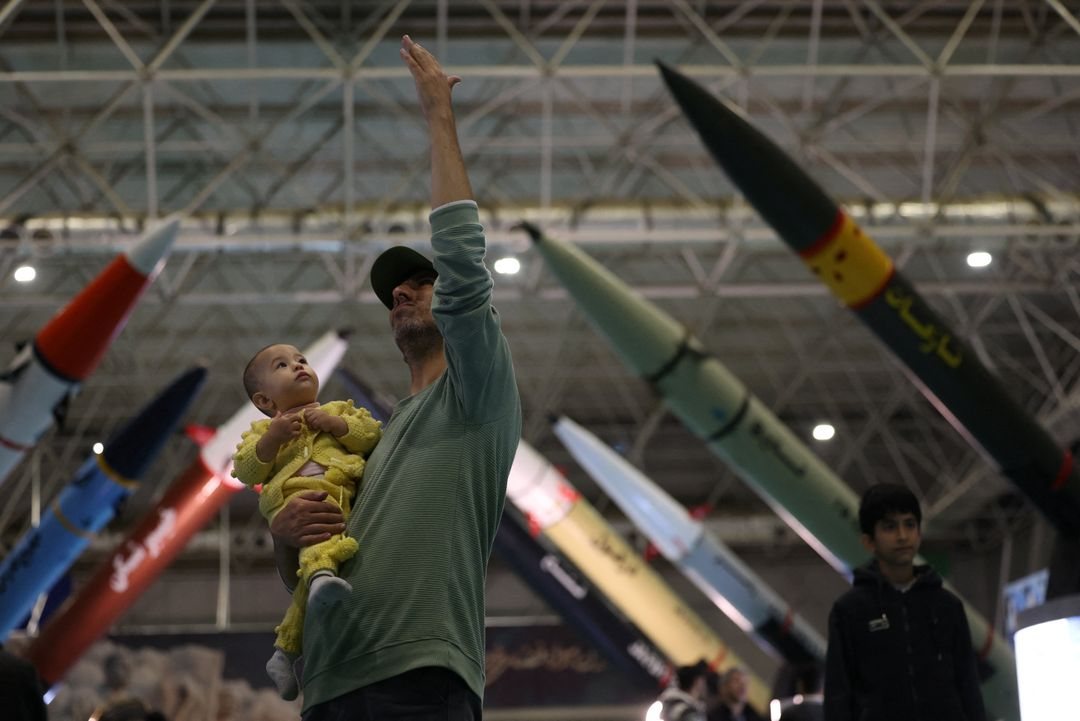
Iran released the footage of a vast underground complex full of ballistic and cruise missiles, mobile launchers and storage areas on November 10.
The footage showed the armed forces chief of staff, Ali Abdollahi, and the Revolutionary Guard (IRGC) Aerospace Force commander, Majid Mousavi, touring the secret site in a jeep. They drove past rows of weapons, including Fattah-1 and Kheibar Shekan, both medium-range ballistic missiles.
Iran has released similar ‘missile city’ videos since 2015, including one in March 2025.
But the latest clip is different from the past videos in three distinct ways, according to Oral Toga, a researcher at the Ankara-based Centre for Iranian Studies (IRAM).
The commanders who appeared in the March video – Mohammad Bagheri and Amir Ali Hajizadeh – were killed in June 2025. Showing their successors in the same setting signals that “decapitation did not break the system”, Toga tells TRT World.
Second, IRGC spokesman Hossein Mohebbi claimed the Aerospace Force had moved missile production underground during the war and built what he called “missile production cities”.
If true, that would mark a shift from earlier videos that focused mainly on storage and launch, not manufacturing, he says.
Third, the footage comes after eight months of sustained US and Israeli strikes that began on February 28.
“So its purpose is to show survivability,” Toga says.
Mustafa Caner, an Iran specialist and assistant professor at Sakarya University’s Middle East Institute, is more cautious in interpreting the video clip.
“This new footage confirms that the storage and the launchers are underground, but it offers no evidence that production has moved there too,” he tells TRT World.
The new footage is primarily a message to the US and Israel that Iran’s war-fighting capacity and its ballistic missile deterrent are still standing, he says.
Both analysts agree that the footage is carefully curated for maximum impact.
Key details like the location, filming date, the number of tunnels, and the number of ready-to-use missiles remain unknown.
Stockpiles’ current status
Caner says that precise figures on Iran’s stockpiles cannot be established from open sources. One reason for this uncertainty, he says, is that all pre-war estimates of Iranian stockpiles proved incorrect.
Toga notes that Iran has fired at least 2,200 ballistic missiles since late February, along with more than 4,900 Shaheds, one-way attack drones with built-in warheads.
Citing estimates reported by Bloomberg News, he says that Iran still reportedly retains 1,700 or more ballistic missiles capable of reaching Israel, while production continues at roughly 50 a month – about half the pre-war rate.
Launchers are another variable, as Israeli and US assessments say more than 200 of roughly 400 were destroyed, he says.
But according to the same assessments, Iran has now reopened tunnel entrances and returned surviving launchers to service, Toga adds.
In Caner’s view, the critical question isn’t how many missiles and launchers Iran has right now.
“It’s whether Iran can sustain its pre-war production rate,” he says, while pointing to solid propellant – a type of rocket fuel – as a potential binding constraint. Iran doesn’t have enough of it, and depends on outside suppliers.
That limitation will matter most if fighting intensifies and lasts a long time, he notes.
Toga says Iran has lost “a large part” of its pre-war capacity, but it still retains its ability to rebuild it.
More than 6,000 weapons that Iran has fired have also consumed at least 1,000 US-made interceptors, he says.
“In this equation, raw numbers matter less than the race between Iran’s production and its adversaries’ interceptor stocks,” he says.
A carefully timed release?
The timing of the footage release is deliberate, analysts say.
It came a week after reported strikes on Qeshm Island and amid speculation that renewed US action can follow the midterm elections.
In the footage, Abdollahi warns that any new attack will draw a response “beyond the region”, which is consistent with Iran’s Supreme Leader Mojtaba Khamenei’s October 31 directive for a “geographically unrestricted” response and an expanded target list.
Toga says the footage has three audiences.
For Washington, the video signals that Iran is seemingly not negotiating from weakness.
The second audience is at the negotiating table in Doha, where Tehran is waiting for an American answer to its seven conditions.
The third audience is domestic, where images of intact facilities and new commanders boost morale at a moment of severe economic pressure, he says.
For Caner, the intended message of the released footage is dual: deterrence against a possible post-midterm election strike by US President Donald Trump, and leverage if Washington prefers negotiation.
As for Israel, the main issue is Iran’s salvo capacity, which refers to the maximum number of missiles it can fire simultaneously or in a single coordinated attack, Toga says.
Estimates show around 1,700 Iranian missiles can still hit Israel. “What matters is not the total, but how many can be launched at once, and underground storage protects exactly that,” he notes.
For the US forces and Gulf states, the greater day-to-day threat remains Iran’s short-range arsenal and drones, which put every US base and much of the region’s energy infrastructure within reach, he adds.
An investigation by the Reuters news agency documented at least 135 attacks by Iran and allied groups on 84 critical infrastructure sites in Gulf countries since the war began.
Meanwhile, Abdollahi’s warning about responses “beyond the region” has already prompted reports of US aircraft being moved from British bases, Toga notes.
He says the combination of factors raises the cost of a short, intense US-Israeli offensive that cannot eliminate a force dispersed across hardened tunnels and still producing roughly 50 missiles a month.
Trump’s decision this week to hold off on new strikes at the request of the Gulf countries – and Secretary of State Marco Rubio’s remark that major combat operations are not needed – fit that logic, he says.
At the same time, Iran's continued rebuilding of infrastructure shortens the decision window for those who favour action before Tehran’s capabilities grow further, he adds.
Iranian commanders now speak of a pre-emptive option, and Israel says it is preparing for that scenario.
“An underground missile network makes a deliberate war costlier, but it does not make an accidental one less likely,” Toga says.
Caner is more restrained on the offensive threat. Iran has released similar footage before, and the record shows it has been the party attacked rather than the initiator, he notes.
However, a pre-emptive strike doctrine is being discussed in Iran more than ever, he says. Yet, the video itself is not evidence that Iran is about to go on the offensive, he tells TRT World.
“The real message is how costly Iran’s response would be if it were attacked, and that its defence and war-fighting capacity can keep it standing for a long time.”
TRT World / Kazim Alam — TRT World
Photo: Reuters