Decades after their deaths in exile and imprisonment, the return of more than 80 ancestral remains is prompting Namibia to confront its colonial past, reckon with its history and ask whether it has become the nation its freedom fighters envisioned.
For decades, they lay far from home. Some died in prison. Others were buried in unfamiliar soil. And for generations, their families were left with memories — but no graves to visit.
Now, finally, they have come home.
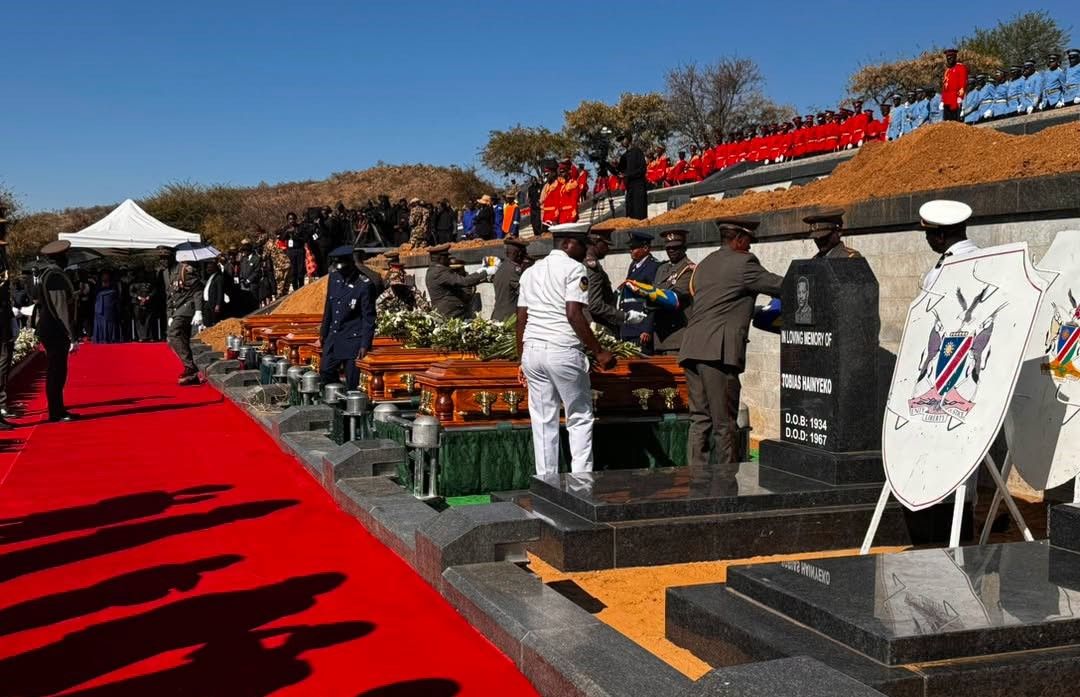
A long convoy of hearses made its way through Namibia's capital, Windhoek, to Heroes’ Acre, carrying the remains of eight liberation struggle heroes on a final journey through the country they had fought to free.
For many Namibians, and especially for the families and loved ones of the fallen, it was a moment of profound emotion — a homecoming decades in the making.
Among those returning were Festus Nehale and Simon Petrus Niilenge, whose remains were repatriated from South Africa on August 21, 2026.
Nehale died in 1971. Niilenge died three years later. Both had been imprisoned on Robben Island during Namibia's struggle for freedom. Both died in Cape Town, where they were buried — far from the land for which they had sacrificed.
Three days after their return, they were laid to rest alongside six other liberation heroes whose remains had been exhumed from burial sites across Namibia.
For Namibian lawmaker Job Shipululo Amupanda, their return carries a significance that goes beyond ceremony.
“It is very important in the soul and imagination of our society.”
He says the repatriation forces Namibia to confront a painful history.
“We come from the bitter history of colonialism and apartheid that took place in our country, and really it was a demonstration of inhumanity to men.”
Restoring dignity, restoring memory
For President Netumbo Nandi-Ndaitwah, the ceremony was about more than bringing human remains back to Namibian soil.
It was, she said, an act of remembrance and restorative justice.
“Through this re-interment, we correct a historical wrong and accord these liberation struggle heroes the honour they earned through their service and sacrifice. What we are doing here today is investing in national memory, reconciliation, identity and the education of generations yet to come.”
For the families, the moment carried a simple but profound message: no hero is forgotten.
Armand Nandjigua, representing the Nehale family, described the occasion as a moment of healing not only for relatives, but for the nation.
“This occasion is more than a family moment. It is a national moment, it is a moment of restoration, remembrance and reconciliation of history.”
And at Heroes’ Acre — the country's war memorial built into the uninhabited hills 10 kilometres south of Windhoek city centre — the president said the fallen had finally found their place among the compatriots with whom they had shared the dream of a free Namibia.
“Heroes’ Acre is a fitting place for this solemn homecoming. It is more than a monument of stone. It is a national sanctuary of memory,” Nandi-Ndaitwa reckoned.
“Here, generations of Namibians will be able to come, reflect and understand that the peace and liberty they enjoy were attained at a great human cost,’’ she added.
“Here, these heroes will rest among compatriots with whom they shared a dream: a free, sovereign and dignified Namibia. Here, their names will speak long after our voices have fallen silent.”
But the two liberation heroes were not the only Namibians whose remains crossed the border from South Africa.
The remains colonialism left behind
Alongside them were the remains of another 84 people from the Herero, Nama, Ovambo, San and Damara communities.
Many were removed during the colonial era and later placed in museum collections for what was described as “scientific” studies.
Museum officials say some were used in “race-based pseudoscientific research” designed to portray Indigenous African people as inferior.
“Those remains represent individuals whose identities were taken away and whose histories were disrupted during the colonial era,” President Nandi-Ndaitwah said.
“As they remain part of our history moving forward, we have to decide on the best way to handle them.”
During the handover ceremony on August 21, 2026, South Africa's Minister of Sport, Arts and Culture, Gayton McKenzie, said bringing the remains home would help restore what had been taken from them: “Their dignity, identity and rightful place in their homeland.”
“This was an injustice to them, their families and their communities,” he added.
For now, the remains of the 84 ancestors have been placed at Namibia's National Museum.
But why were the remains of Namibian heroes and ancestors in South Africa in the first place?
The answer lies in the two countries' deeply intertwined colonial history.
After Germany's colonial rule, South Africa took control of what was then known as South West Africa.
Its rule extended for decades and through the apartheid era, ending only when Namibia gained independence in 1990.
During those years, Indigenous communities faced dispossession, violence and racial discrimination.
Many were taken from their communities, and some of their remains eventually ended up in institutions and museum collections across southern Africa and Europe.
Beyond the graves: what freedom means today
For Amupanda, however, bringing the remains home is only one part of a much larger process.
The former mayor of Windhoek believes Namibia must do more to record its history and preserve its collective memory.
“Colonialism did not just attack the physical body and the imposition of power in all those institutions. The colonial project also disfigures our imagination, how we see ourselves – what we call in political science and decolonial studies, in particular, coloniality of being, we still have coloniality of knowledge.”
But Amupanda also raises a difficult question. How should a younger generation honour the sacrifices of liberation heroes without becoming trapped in the past?
He says there is a growing disconnect between his generation and the generation that led the liberation struggle.
Namibia, he argues, must be grateful for its freedom while also recognising that political independence did not solve every problem.
“We are very grateful of what they've done to us, and of course, we will never betray their sacrifices. But we will not live in the past. We don't want to be a generation that just spends a lot of their time by the graves of our parents and heroes, so we need to be able to move on and build from what they have done.”
For Amupanda, that means confronting the realities facing Namibia today.
“We are one of the most unequal nations on the face of the earth. Unemployment is so high, there's many problems that we have.”
The task of his generation, he says, is to build on the freedom won by those who came before them.
“Granted, they've done very well in freeing our country. They've done very well in stabilising our country, but they've done a terrible job as far as the socioeconomic opportunities and redesigning and re-imagination and repositioning of our people is concerned, and that becomes our responsibility.”
The sentiment echoes the words of President Nandi-Ndaitwah herself.
As Namibia buried its heroes, she said the country's greatest tribute to them could not simply be to remember their names. It had to be to fulfil their dream.
“The highest tribute we can pay them is not only to say their names, but to build the Namibia for which they struggled: a Namibia in which every citizen lives in dignity; where opportunity is broadened; where poverty is defeated; where justice is protected; and where our unity remains stronger than the forces that seek to divide us.”
For the repatriated ancestors and heroes laid to rest at Heroes’ Acre, the long journey is finally over. They have returned to the soil of the country they fought to liberate.
But for Namibia, the journey they began is still unfinished. Because perhaps the truest way to honour those who gave their lives for freedom is not simply to bring them home. It is to build the home they dreamed of.