Imagine being able to rehearse a job interview, navigate a tricky conversation with a colleague or simply build the confidence to walk into a workplace — all before actually setting foot in one.
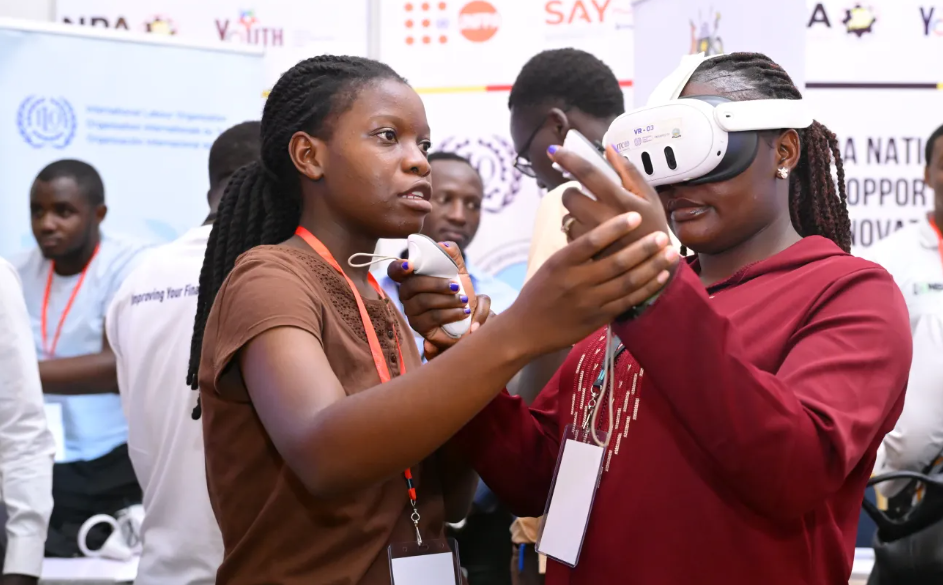
Sandra Nakato had never put on a virtual reality headset before. When she did at the Uganda National Youth Opportunity and Innovation Conference in Kampala, she froze for a moment, then laughed — and then realised she was standing in a simulated job interview.
"I kept thinking, this is just a machine," she said. "But when the questions started coming, I felt like I was really there. That's when I understood — this is how you learn to be ready."
Imagine being able to rehearse a job interview, navigate a tricky conversation with a colleague or simply build the confidence to walk into a workplace — all before actually setting foot in one. That is the promise of Workverse, a virtual reality (VR) learning initiative supported by the International Labour Organization (ILO) through its PROSPECTS programme.
In a rapidly changing world of work, technical know-how alone is no longer enough. Young people need communication, teamwork, empathy and adaptability — yet few get the chance to practice these skills in a safe, supportive environment. The gap is especially wide for those facing barriers to education and employment, including refugees and host communities.
To help close that gap, the ILO joined forces with the International Training Centre of the ILO (ITCILO) and the Uganda Institute of Information and Communications Technology (UICT) to present Workverse at the inaugural Uganda National Youth Opportunity and Innovation Conference (UNYOIC) on 18 September, 2026.
Learning by doing
Workverse was launched in 2025 through ITCILO's Innovation Sparks Initiative and uses VR to place young people in simulated workplaces where they can rehearse job interviews, practise communicating with colleagues and learn how to handle everyday workplace interactions.
The initiative brings together complementary strengths: ITCILO's expertise in innovative learning, UICT's grasp of local training needs and the ILO's commitment to inclusive skills development.
The project seeks to widen access to practical learning for young people, including refugees and host communities.
It was first put to the test in Uganda’s Nakivale Refugee Settlement where young people were introduced to VR learning tools and trainers from UICT and other institutions explored how the technology could sharpen communication and interpersonal skills.
That exploration became something tangible at the recent UNYOIC conference in September where youth representatives drawn from districts across Uganda tried Workverse for themselves.
For Sandra Nakato, one of the youth representatives, the experience simplified how virtual reality could help young people build confidence before they ever enter a workplace.
"It’s a great experience because it teaches how to communicate with interviewers and how to answer interview questions which is crucial in being the best candidate for a job," she states.
Inclusive innovation
The two-day conference was convened by Uganda's National Planning Authority (NPA), in collaboration with the Population Scientists' Association and the United Nations Population Fund (UNFPA), drawing together young people and stakeholders to explore opportunities in technology, innovation, education and employment.
Isaac Oketcho, another invited youth representative, was struck by how quickly he could interact with the virtual environment — and saw in it a way to carry training beyond the major urban centres.
"It’s possible to have virtual reality trainings happening across the country to bring this technology to more people including those living in the remotest parts of Uganda," Oketcho states, noting how people living with disabilities would possibly not have to travel long distances to access the training.
As Melissa Kyeyune, National Project Coordinator for Digital Skills and Microwork under ILO PROSPECTS, elaborates: "It is this kind of direct engagement with young people that gives innovation its value and relevance."
But the conference also served as a reminder that opportunities and commitments mean little unless they translate into tangible results.
Uganda’s National Planning Authority noted that the success of the virtual reality training conference will be judged by the number of commitments achieved by youth leaders as champions for improved access and better outcomes for young people.
For Sandra Nakato, the headset came off, but the lesson stayed with her.
"I used to be afraid of interviews," she says. "Now I know I can stand in front of anyone and speak for myself. This is not just a machine — it's a chance to change my life."