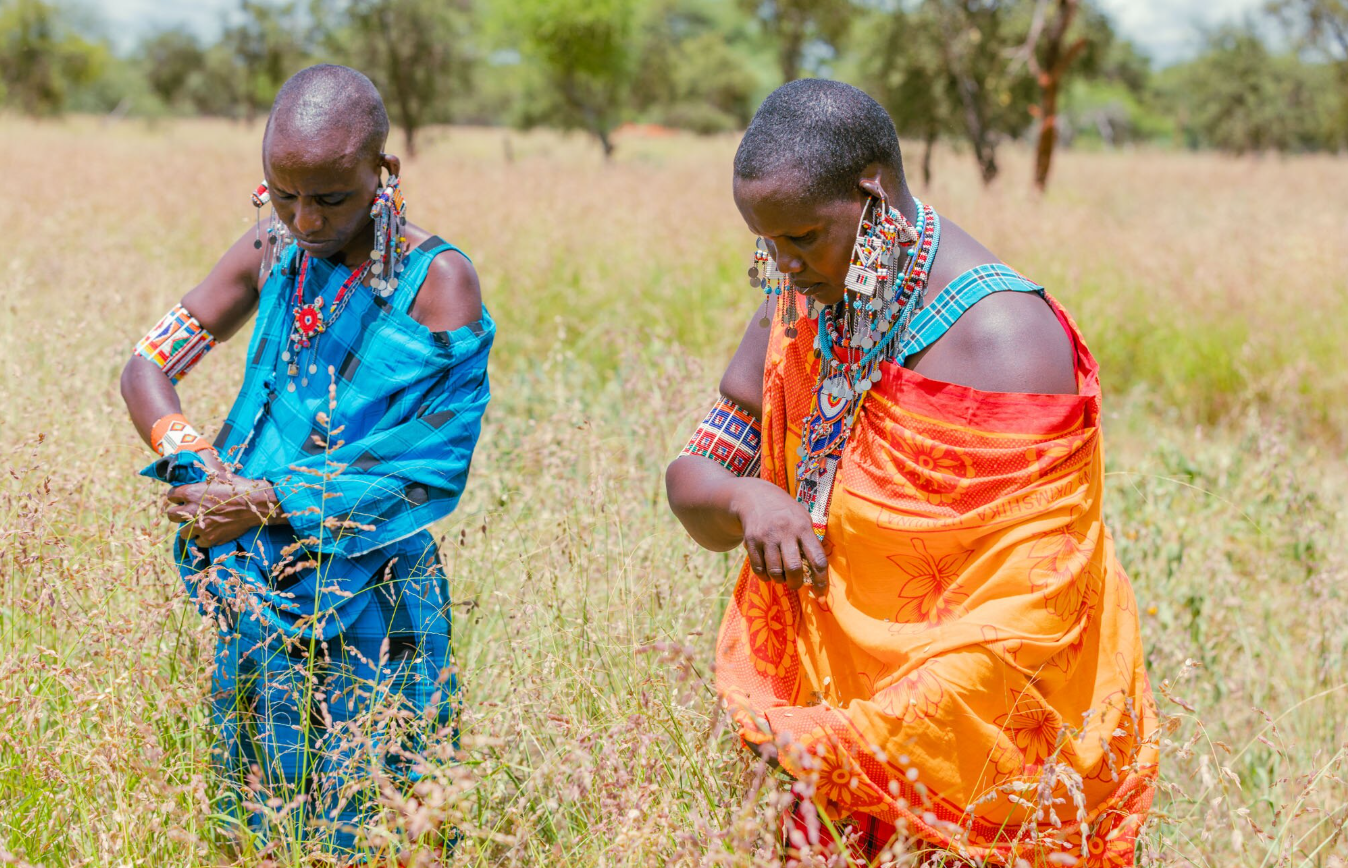
A section of cooperatives in Kenya are making profitable business from hay storage; turning seasonal surplus into year-round animal-feed supply that becomes a lifeline for livestock keepers when drought strikes.
Sanaiyan Selina remembers the morning in 2022 when her husband returned from the market with news that made her stomach drop. He had sold a cow—one of their last healthy animals—for 10,000 shillings. A sum that hardly covered their college-going daughter’s first semester tuition.
The drought that swept through Kajiado County that year claimed more than a million livestock, and families like Sanayian’s watched helplessly as their life savings withered and died.
“We lost almost everything,” Selina tells TRT Afrika, as she stands outside her homestead in Oloirimirimi Village. “My children asked for milk, and I had to tell them we were waiting for the rains. But the rains never came.”
Today, Selina owns five cows, thirty-five goats, and twenty-five sheep—livestock she purchased through her women’s group’s table banking initiative.
But she knows that ownership alone is not enough. Without feed, animals are liabilities, not assets. This is why she pays close attention to a new model being tested in her county: hay aggregation and storage as a business.
‘Hay race’
The problem, says Paul Nchake, chairperson of the Ilaramatak Mechanization and Marketing Cooperative Society, is not that Kajiado lacks hay. After the long rains, the plains turn emerald green, and producers race to cut and bale Rhodes grass. The challenge is timing.
“Everyone sells at once,” Nchake explains. “The market floods, prices crash, and farmers get almost nothing. Six months later, the grass is gone, bales are scarce, and the same farmers are buying hay at triple the price just to keep their animals alive.”
During the 2022 drought, a 15-kilogram bale of hay jumped from 150 to 400 shillings in just six months. Some livestock keepers took loans to buy fodder. Others watched their herds die.
The losses extend beyond the animals. Ilaramatak estimates that poor storage and handling destroy between 40 and 60 percent of hay after harvest. Across Kajiado, barns built by individuals, communities, and the county government sit underused.
“A barn is not a business,” the ILO report notes. “Someone has to buy hay at harvest, finance it while it waits, protect its quality, and find a buyer”.
That’s exactly what Ilaramatak is now trying to do. Since mid-2026, the cooperative has worked with an International Labour Organization-supported project to test hay aggregation and storage as a commercial enterprise.
The model is straightforward: Ilaramatak buys hay from registered producer groups under agreements covering volume, quality, price, and payment. It grades bales for moisture, density, and mould. Then it stores them across a network of barns and sells to feedlots, dairies, traders, and ranches as demand rises.
“The intention is to treat storage as a service, not a charity,” Nchake says. “Producers get paid at harvest. Buyers get quality feed when they need it. The cooperative covers its costs and reinvests.”
Women-led workforce
For women like Sanaiyan, the model matters because storage is also a gender question. Maasai women contribute more labour to livestock production than men, yet men traditionally control the income. Women’s groups across Kajiado Central are using table banking to buy their own animals and become active in fodder production.
“When I first bought my own goats, some people laughed,” Sanaiyan says. “Now they ask me how I did it.”
One of the barns identified for the pilot is already run by a Maasai women’s cooperative. The International Labour Organisation (ILO) project is explicit about its intention: women should be suppliers, workers, traders, and barn managers—not just beneficiaries.
Dr. Ruth Kiraka, a lecturer at Strathmore University who leads the Kenya Pastoral Market Development programme, has seen how livestock ownership transforms women’s standing in their communities.
“When women control livestock income, they invest differently,” Kiraka says. “We’ve seen literacy levels rise, school fees get paid, and nutrition improve. From our baseline in 2023 to now, productivity has doubled in the households we are tracking”.
But Kiraka cautions that storage alone won’t solve the underlying problem.
“The hay business model only works if there’s reliable demand and farmers can access credit to hold their stock. Otherwise, you’re just moving the bottleneck,” she says.
Reliable year-round market
The stakes are high.
Livestock trade in Kajiado is worth roughly 3.2 billion Kenyan shillings annually—about US$24.6 million, according to ILO. When drought hits, that entire economy collapses. The pilot’s central question is whether commercially managed aggregation and storage can turn seasonal surpluses into a reliable year-round market.
For Sanaiyan, the answer is already becoming clear. She has started setting aside a portion of her fodder instead of selling everything at harvest. Last month, she sold three goats at a price she would have been grateful for during the drought. Her youngest child is enrolled in school, and she recently helped her husband pay for roofing materials for a new kitchen.
With El Niño rains projected for October 2026, the uncovered hay bales dotting Kajiado’s fields are a reminder that time is not on the side of the unprepared. But for the first time in generations, some families are betting that the next drought won’t catch them empty-handed.
“I used to think wealth was something my husband brought home,” she says. “Now I know I can build it myself. And when my daughters ask what they can become, I tell them: anything. Even the thing that men told us was impossible.”