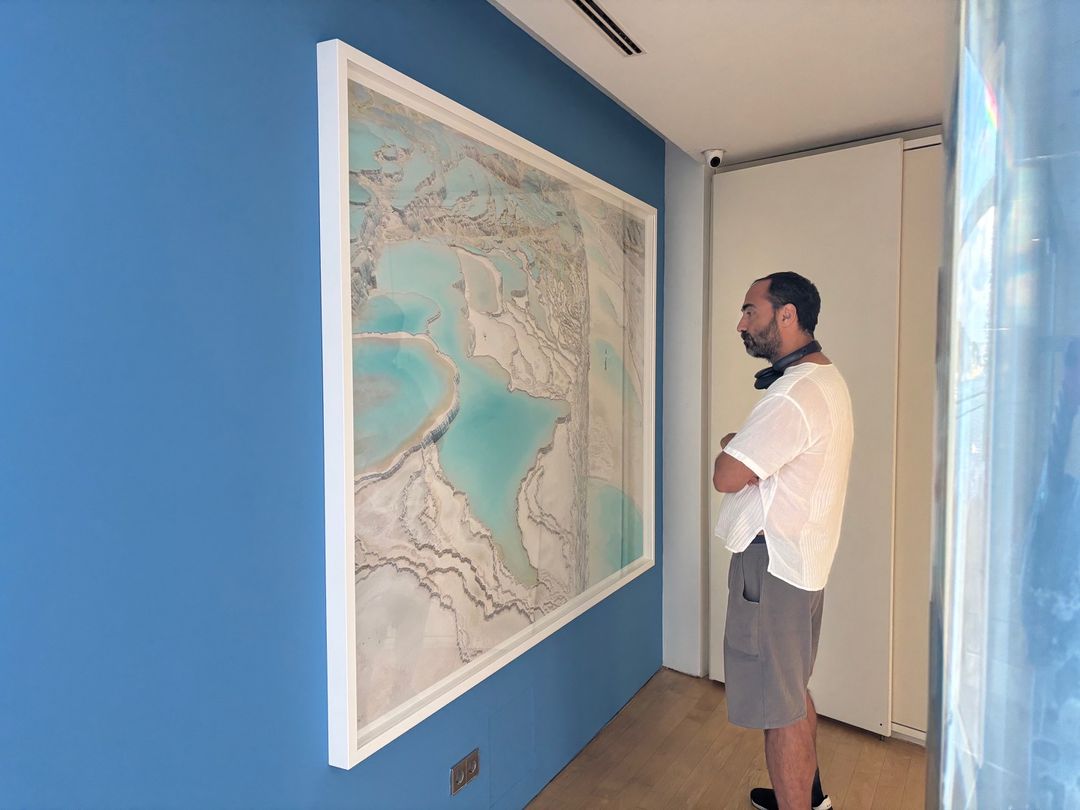
Several of Türkiye’s ancient sites and landscapes are part of the award-winning Italian artist's unique perspectives from around the world showcased at an ongoing exhibition in Istanbul.
Olivo Barbieri says he has been photographing for nearly fifty years.
He is reticent about revealing his preferred cameras and lenses, shrouding his methods in an air of mystery: “I have made use of every possibility that technology has successively made available, from 8x10 inch analogue to 150 megapixel digital”.HisNew York gallerysuggests he has used a large-format analogue camera as a starting point for his magic.The Italian photographer’s view of Türkiye’s ancient past is part of an exhibition at Borusan Contemporary.The exhibition running until mid-August next year also features works spanning his stellar career.His Türkiye photographs, commissioned by Borusan Contemporary under the headingTime Space Geometry, depict nine archaeological sites in Türkiye, including Ephesus, Aphrodisias, Hierapolis and Laodikeia.Barbieri, born in Carpi, Italy, in 1954, now lives in Modena.
He is known in international art circles for challenging how we look at images.He has photographed around the world, fromChinato theUS, from theAlpstoCapri, fromNew YorktoIstanbul, and fromNiagara FallstoVictoria Falls, always finding something new for viewers to notice even if we think we already know the subject of the photograph.HisTime Space Geometryis one of two exhibitions currently running at Borusan Contemporary, housed in Perili Kosk – or “Haunted Mansion” – and serving as Borusan Holding’s headquarters during the workweek and an art space at weekends.Rather than hanging in a sterile gallery with bare white walls, Barbieri’s photographs are scattered around office spaces overlooking the Bosphorus.Borusan Contemporary is concurrently hostingHaunted.
A single ticket provides access to both exhibitions.The exhibition also includes a photograph of Istanbul taken from a helicopter in 2011, part of Barbieri’ssite specific_series.“Istanbul is an ancient city rich in historical vestiges.
It is a place of connection between East and West – or West and East – and a potential point of equilibrium in dialogue with Rome, New York, and Shanghai,” he says.‘Image of reality’Curator Firat Arapoglu says Barbieri’s photographs “begin with recognizable subjects—a city, an archaeological site, a mountain, a waterfall—but very quickly turn into questions about perception”.According to Arapoglu, Barbieri connects the geographically distant locations of the different series he has produced “through a single question: How is the world transformed by the way we look at it?”Barbieri says it all goes back to the late 1990s, when he was “annoyed” by claims that suggested photography was a depiction of reality, “something that was almost never true”.So he set out to prove them wrong.“Using the technique of selective focus, I devised a process that allowed me to indicate the starting point for reading the image, much like a page of text,” he says.“It was only then that I realised the image of reality was transforming into a scale model, a maquette.”His technique, perfected over the years, has resulted in “a novel way of interpreting the visible world”.
Barbieri says he later started using helicopters “to see what would happen from a floating vantage point”.When asked what he would say to a visitor encountering Barbieri’s work for the first time, Arapoglu says: “I would first tell the visitor not to concentrate only on what Barbieri has photographed, but on how he makes us look at it.
That distinction is fundamental.”Arapoglu believes that describing Barbieri’s manipulation of “focus, scale, perspective, and colour, particularly through the selective-focus strategies associated with hissite specific_project” simply as a “miniature effect” would be misleading.He brings up the ancient sites in Türkiye that Barbieri was commissioned to photograph: “What he gives us is not a ‘better view’ of antiquity.
He gives us an unfamiliar view of something excessively familiar.”When asked whether he makes any modifications or corrections to the images before he prints them on a massive inkjet printer, Barbieri says: “I never intentionally alter the form of the object or subject being depicted.
These interventions serve only as tools to subliminally emphasize potential hidden meanings within the image.”He adds: “Very often, I do nothing.”Does Barbieri have an idea of the final image in his head as he takes a photograph, or does the initial output guide him?The photographer says: “I always have an ideal image in mind that I want to create, but it is rarely the right one.
During the shooting and selection process, I almost always discover something unexpected that surpasses my initial intent.“This is the most interesting aspect of the practice.”Olivo Barbieri’sTime Space Geometryexhibition, so named because “the sites depicted were built according to precise mathematical laws”, can be viewed at Borusan Contemporary on Saturdays and Sundays from 10 am to 7 pm.Barbieri adds that these laws, “in the form of artworks, appear as technological images, algorithms from the past” and are “the necessary completion of thesite specific_project” that he began in 2003.
Firing of three researchers follow a wave of public warnings from researchers at OpenAI and Anthropic about risks of accelerating AI development and threat to humanity.
Musk will be co-leader of project alongside Palmer Luckey, the 34-year-old co-founder of defence technology firm Anduril Industries, and Newt Gingrich, the 83-year-old Republican ex-House speaker.
US Navy says contract is meant to provide steady and reliable supply of SM-6, a missile that can carry out both offensive strikes and missile defence missions.