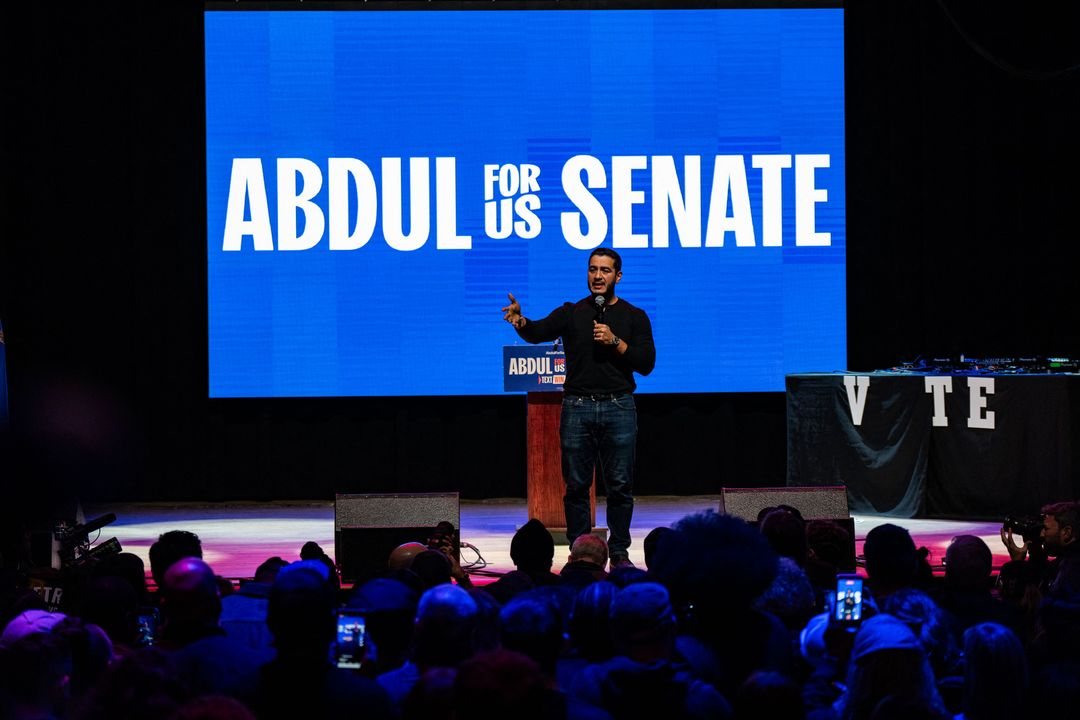
Hollywood actor and musician express support for Democratic candidate Abdul El-Sayed, who faces Republican Mike Rogers in a closely watched Senate contest in Michigan.
Hollywood actor Mark Ruffalo and musician Bruce Springsteen have endorsed Democratic Senate candidate Abdul El-Sayed in the US midterm elections in Michigan.
Ruffalo expressed his support for El-Sayed in a campaign video, highlighting the candidate's positions on economic and social issues.
"I just want you to know how proud I am to support Abdul El-Sayed," Ruffalo said.
The actor, who was born in Kenosha, Wisconsin, also spoke about the importance of working-class communities and government policies that address their needs.
He cited family, employment, community development and investment in future generations as issues influencing his political preferences.
Springsteen separately endorsed El-Sayed in a social media post, expressing support for the candidate's positions on constitutional and democratic principles.
"That's why I'm in his corner 100 percent," Springsteen wrote.
The endorsements come as El-Sayed campaigns against Republican candidate Mike Rogers for Michigan's open US Senate seat.
Eye on 2028 presidential election
El-Sayed, 42, defeated former Representative Haley Stevens in the Democratic primary on August 4 and is seeking to become the first Muslim US senator if elected.
The Michigan race is among several contests that could influence the balance of power in the US Senate.
El-Sayed, a former Wayne County health director and epidemiologist, has focused his campaign on healthcare, affordability and expanding social welfare programmes.
Rogers, a former congressman, has emphasised manufacturing, border security and conservative economic policies.
The candidates also differ on foreign policy and social issues, reflecting broader divisions between the Democratic and Republican parties.
El-Sayed has been critical of Israeli government policies and supports proposals such as universal healthcare, while Rogers has positioned himself as a conservative alternative.
The outcome could also carry implications for the direction of the Democratic Party ahead of the 2028 presidential election.
Democratic divisions emerge ahead of vote
The Michigan contest drew further attention on Sunday when Stevens, who lost to El-Sayed in the Democratic primary, announced her endorsement of Republican candidate Rogers.
In a statement, Stevens said her decision was independent and based on her personal convictions, rejecting suggestions that her fiance or outside political figures had influenced her position.
The endorsement followed disagreements between Stevens and El-Sayed over remarks concerning Israel and a political advertisement that some critics described as antisemitic.
El-Sayed disputed the advertisement's claims and said it had not been produced by his campaign.
Stevens was subsequently excluded from a Sunday campaign event involving Democratic figures, amid reported efforts to address tensions within the party.
The Democratic primary had also attracted significant attention from pro-Israel political organisations, including AIPAC-affiliated groups, which supported Stevens during the nomination contest.
The disagreement reflects divisions within the Democratic Party over US policy towards Israel and the war in Gaza.
Meanwhile, President Donald Trump has criticised El-Sayed and other Democratic candidates during the election campaign, questioning their political positions and suitability for office.
In remarks delivered on Monday ahead of Election Day, Trump described the Democratic field as politically extreme and urged voters to support Republican candidates.
The Michigan Senate race remains a closely watched contest, with both parties seeking to strengthen their positions in Congress.
TRT World and Agencies — TRT World and Agencies
Photo: AFP