Kenya buries first Ebola victim as number of contacts linked to patient rises to 57
Editor:
Tuğçe Nur Kaya


Health cabinet secretary says 10 people are in quarantine as authorities intensify tracing following country's first confirmed case.
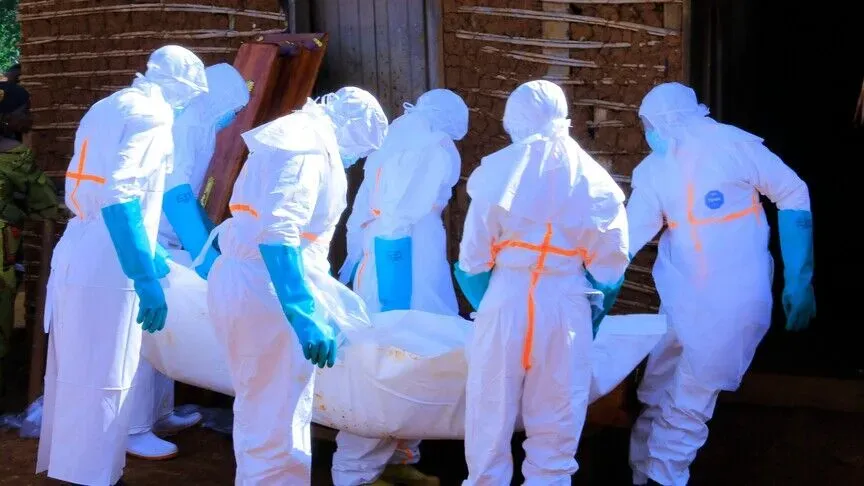
Kenya conducted its first Ebola burial under strict health protocols after a Kenyan man became the country’s first confirmed case and death from the disease, as authorities stepped up efforts to prevent further transmission.
The patient was buried Wednesday at Lang'ata Cemetery, about 7 kilometers (4.3 miles) southwest of Nairobi's central business district, under strict health protocols designed to prevent transmission of the virus.
Health Cabinet Secretary Aden Duale said Kenya does not currently have an Ebola outbreak, stressing that the only confirmed infection was imported from the Democratic Republic of Congo.
Authorities have expanded the number of people identified as having had contact with the patient from 55 to 57, according to Duale.
Symptoms monitoring
"Of the initial 55 identified contacts, an additional two have been added, bringing the total (number) of contacts to 57. Ten of them have been accounted for, and they are already under a quarantine facility," he said.
"They're undergoing daily symptom monitoring at the National Police Service Hospital in Nairobi. Efforts today to trace the remaining contacts have been intensified, and by the time I was coming here, close to about 17 have been traced and they are already at the location," he added.
The 10 people in quarantine are being monitored for symptoms, while health teams continue efforts to locate and monitor the remaining contacts.
The deceased was a Kenyan citizen who had been living in Congo, where he became ill before traveling by road through Uganda and flying to Nairobi on Oct. 3.
He was taken to Nairobi Hospital and isolated before laboratory tests confirmed Bundibugyo virus disease, a rare and severe viral hemorrhagic fever caused by the Bundibugyo ebolavirus.
The patient died days later, prompting authorities to step up contact tracing and surveillance. Kenya has screened more than 652,000 travellers and tested 267 suspected samples since going on heightened alert over Ebola, while nearly 5,000 health workers have been trained in prevention and case management.
Ebola spreads through direct contact with the blood or other bodily fluids of an infected person or through contaminated materials.




CAS to hear Senegal's appeal on 2025 AFCON title awarded to Morocco
Senegal are contesting the Confederation of African Football's decision to declare Morocco champions, despite Senegal beating the hosts 1-0 after extra time.
Kosovo swears in Shiroka-Pula as president, averting snap elections
Prime Minister Albin Kurti welcomes Shiroka-Pula's election, describing it as a sign of institutional stability.
Merz warns extremism is entering German parliaments after AfD victory
The election of AfD lawmaker Tobias Rausch as Saxony-Anhalt’s state parliament president has intensified debate over Germany’s political firewall and put pressure on Chancellor Friedrich Merz.




All rights reserved. Newstimetr © 2026