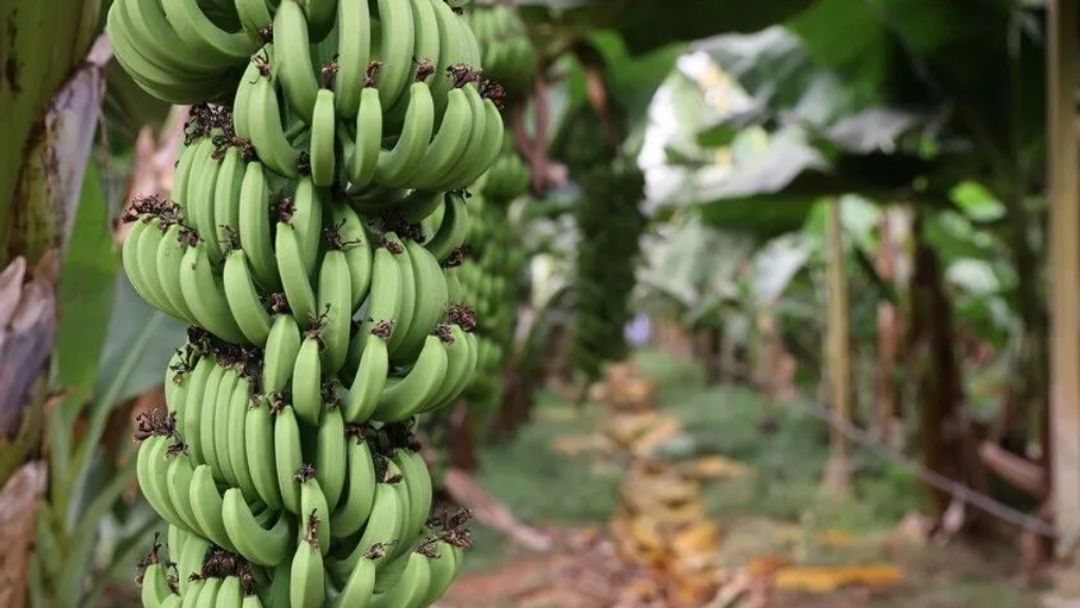
Anamur, which accounted for nearly a quarter of Türkiye's banana production in 2025, showcased its famed fruit at COP31, with Armenian Prime Minister Nikol Pashinyan even carrying one across four countries before eating it.
A banana grown on Türkiye’s Mediterranean coast is finding an international audience at the COP31 climate conference, giving visitors a taste of Anamur while putting the district’s agricultural identity on display.
Two truckloads of Turkish bananas, which were grown in Mersin province's Anamur district, were distributed to participants in Antalya, local growers told Anadolu. They estimated the shipment contained around 400,000 individual bananas.
Armenian Prime Minister Nikol Pashinyan also drew attention to the fruit, carrying a banana offered at his Antalya hotel through four countries after leaving Türkiye before finally eating it in a video shared on social media.
In his latest post, Pashinyan likened his travels to following in the footsteps of explorer Ferdinand Magellan. He listed a route from Antalya to Dublin in Ireland, Yerevan in Armenia, New Delhi in India, and Phnom Penh in Cambodia, before returning to Yerevan.
At the end of the video, he peeled and ate the banana. Earlier posts from Dublin and Yerevan had shown him taking the fruit out of his pocket, attracting attention on social media.
Pashinyan arrived in Antalya on November 11 to attend the COP31 Leaders’ Summit. His subsequent schedule included the European Political Community summit in Dublin, a meeting with Indian Foreign Minister Subrahmanyam Jaishankar during a New Delhi stopover, and the International Organization of La Francophonie summit in Phnom Penh.
While one banana accompanied a visiting leader abroad, the truckloads distributed at COP31 introduced other international visitors to one of neighbouring Mersin province’s best-known agricultural products.
A major growing district
Anamur accounted for nearly a quarter of Türkiye’s banana production in 2025, local growers said, highlighting the district’s importance to the domestic market.
Figures published by agricultural data platform CONA, citing the Turkish Statistical Institute, put Anamur’s production of bananas, plantains, and similar products at 207,900 tons in 2025, cultivated across 32,100 decares, or 32,1 square kilometres.
The district accounted for approximately 53 percent of Mersin’s 392,347 tonnes of production in the same category, according to the dataset.
From the harvest to the conference
The gathering coincides with the busiest part of Anamur’s harvesting calendar.
Although bananas are harvested throughout the year, activity peaks from October through March, according to local authorities and the product’s geographical indication documents. Greenhouse cultivation helps sustain production beyond the main season.
Anamur bananas were registered as a designation of origin on July 9 2003, with protection effective from June 2 2002, according to the Turkish Patent and Trademark Office.
The protected growing area covers Anamur and Bozyazi in Mersin, along with Gazipasa and Alanya in Antalya, linking the product’s identity to a broader stretch of Türkiye’s Mediterranean coast.
Growers cultivate the fruit in both open fields and greenhouses. Under suitable conditions, a whole fruit bunch can weigh between 20 and 60 kilogrammes (44-132 pounds), according to the registration document.
Local authorities describe the banana’s aroma and peel characteristics as distinguishing features, giving producers a regional identity to present alongside the fruit itself.
For Anamur’s growers, the conference offered an opportunity to associate their district’s name with a fruit visitors could taste for themselves — and, in Pashinyan’s case, carry well beyond the Mediterranean coast.
TRT World / Anadolu Agency — TRT World / Anadolu Agency
Photo: َAA