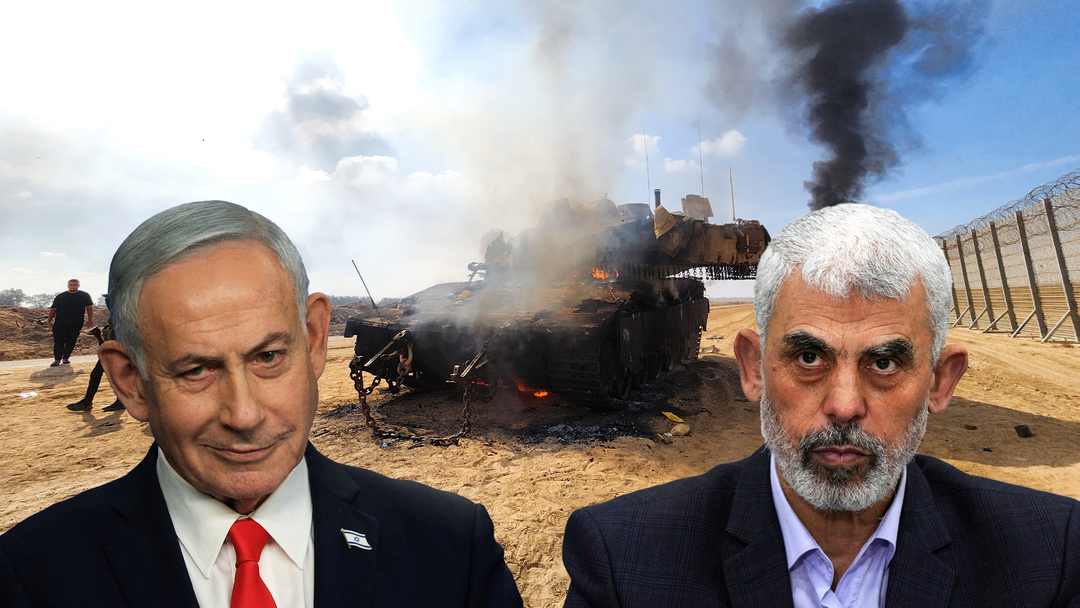
As Israel heads towards crucial elections, fresh revelations about warnings preceding the Hamas attack revive questions over Netanyahu’s political calculations, his handling of the threat and the war that followed.
The warning was clear and hard to miss.“Convey a message to them that I am preparing the mother of all surprises.
A terrifying operation.
Something extraordinary.”The words, attributed to Hamas leader Yahya Sinwar, were passed to a Palestinian intermediary in the weeks before October 7, 2023.
According to arecentHaaretz investigation, they would eventually travel through Abu Dhabi and reach the highest levels of the Israeli government.Sinwar, assassinated by Israel later, reportedly used the word zilzal, Arabic for earthquake, to describe what awaited them.Weeks later, Hamas fighters broke through the Gaza boundary and launched an attack that stunned Israel and reverberated across the Middle East.For much of what followed, October 7 was portrayed as a catastrophic failure of Israeli intelligence and security.But three years later, a series of revelations in the Israeli media is raising a more troubling question: How much did Prime Minister Benjamin Netanyahu know before the attack?Reports by Haaretz and Yediot Ahronot suggest Netanyahu and his aides had received warning about a looming Hamas blitz.The revelations emerged in September, just weeks before Israel's October 27 general election, bringing renewed scrutiny of Netanyahu's handling of the warnings as he seeks another term in office.Those accounts point not to a single warning, but to messages that travelled through Palestinian intermediaries, the Emirati leadership and, according to other reports, Egyptian intelligence.After different rounds of consultations with his advisers, the UAE leaderMohamed bin Zayed Al Nahyan, the Crown Prince of Abu Dhabi,decided to inform Netanyahu about Sinwar’s designs in mid-September.While Netanyahu quickly organised a security meeting, which discussed warnings, at the end Israeli leadership did not make any serious decisions and preparations on Hamas’ potential attack planning.“Everyone on the face of this planet informed them (Israelis),” Dania Koleilat Khatib, an expert on Arab-American relations with extensive experience with Gulf leaderships, tellsTRT World.According to Khatib andIsraeli sources,the Palestinian intermediary “Coal Eyes” was Sufyan Abu Zaida, a former Minister of Prisoners and Former Prisoners' Affairs in the Palestinian Authority, with whom the analyst met in the past in Prague.Khatib also says that Zaida’s close friend in Abu Dhabi is Mohammed Dahlan, a former top Fatah official and an adviser to Mohammed Bin Zayed.“It is not a conspiracy anymore.
There is more and more indication that Netanyahu knew about it.
Egyptians told him, Coal Eyes (Zaida) told him, and the Emirati leadership told him,” says Khatib.Both Haaretz and the Wall Street Journalreportedthat in early October 2023 Egyptian intelligence chief Abbas Kamel also personally warned Netanyahu about an impending Hamas attack to no avail.Netanyahu denied reports of warnings from Egypt and the UAE, claiming that neither the UAE leadership nor Egyptian intelligence informed him.
He called the UAE warning report “an absolute lie” and said that “no Israeli intelligence source conveyed an Egyptian warning to the Prime Minister”.But according to the WSJ, citing Arab officials, Kamel personally called Netanyahu to convey the imminent threat in a third warning after his previous two warnings went to deaf ears.Despite Netanyahu’s denials, neither the UAE nor Egypt issued any statement about their warnings to the Israeli leadership.Netanyahu’s calculationsBefore the October 7 attack, Israel and Hamas had been engaged in serious negotiations, with Sinwar seeking to lift Israel’s blockade of Gaza.“Sinwar wanted to lift the blockade on Gaza and promised if they don't, there will be an earthquake,” Khatib says.Sinwar, who learned Hebrew during his imprisonment in Israeli jails, was also aware of Israel’s deepening political divisions.Netanyahu was facing corruption charges and widespread protests over his proposed judicial overhaul, which critics described as a“judicial coup”.Netanyahu, meanwhile, was struggling with mounting political problems, as former mainstream allies distanced themselves from him over questions about his credibility.Khatib believes Netanyahu saw a possible Hamas attack as an opportunity to strengthen his political standing.“Netanyahu was facing corruption charges.
People were protesting against his attempt to change the judicial system to escape accountability.
The society was highly divided.
And October 7 was a good excuse to shove everything under the rug,” Khatib tellsTRT World.But according to the analyst, Netanyahu’s calculations went beyond his immediate political survival.While the first purpose was “to evade the ongoing scrutiny, the second was to launch a war on several fronts and achieve the dream of Greater Israel,” Khatib says.“Actually, the two are linked together.
If he achieved a victory and enlarged Israel, then the Israeli people would forgive him.
This is why it is difficult for him to stop.”Haaretz also reported that Hamas was initially prepared to release civilian hostages without conditions after October 7, but Netanyahu rejected the proposal, with the report attributing to him the position that “he only wants war and the elimination of Hamas”.For Khatib, the account lends weight to her interpretation of Netanyahu’s broader political objectives.Other analysts also argue that Netanyahu sought to use the October 7 attack to advance a wider agenda, including territorial expansion and the forced displacement of Palestinians.Despite decades of Israeli policies and efforts since the state's establishment in 1948, Israel has been unable to secure an overwhelming Jewish majority across historic Palestine, says Sami al Arian, a Palestinian professor and director of the Center for Islam and Global Affairs at Istanbul Sabahattin Zaim University..“They found an opportunity in these attacks to embark on ethnic cleansing and genocide to force Palestinians out of their land to resolve Israel’s population problem,” Arian tellsTRT World.War of narrativesThe latest revelations about Israel-Hamas negotiations and warnings reportedly received by Netanyahu before October 7 also highlight how different sides of the Israeli-Palestinian conflict have sought to shape international perceptions of the attack and the subsequent war in Gaza.Netanyahu and his allies have portrayed October 7 as a brutal Hamas attack on Israeli civilians, while recent Israeli media investigations suggest the country's leadership had received warnings about the scale of the operation being planned.The revelations raise further questions about Netanyahu's handling of those warnings, particularly as Israeli officials used the attack to justify a devastating military offensive in Gaza.The Biden administration, which was also reportedlyinformedby UAE President Mohamed bin Zayed about a possible Hamas attack, backed Israel's military response as an act of “self-defence”, even as the offensive killed tens of thousands of Palestinians.Palestinian analysts, however, say the debate over who knew what before October 7 risks overlooking Hamas’s own agency and the warnings it had issued.Ramzy Baroud, a Palestinian political analyst and writer, argues that focusing primarily on warnings passed through regional governments can obscure that part of the story.“The media’s hyper-focus on third-party state warnings ignores a glaring reality—Palestinians themselves issued explicit, direct warnings,” Baroud tellsTRT World.Sinwar’s impending "earthquake" and "roaring flood" warnings were “open and documented,” he adds.For Baroud, overlooking these warnings reflects a broader tendency to deny Palestinians agency in shaping events.“This reflects a historical refusal to recognise Palestinian agency.
Israel has long viewed Palestinian resistance through a paternalistic lens, convincing itself that native uprisings are merely top-down manipulations to be managed through periodic military campaigns like ‘mowing the lawn’.”His argument introduces another dimension to the debate over Netanyahu's foreknowledge.
Even if the Israeli leadership received warnings and failed to act, Sinwar had his own strategic objectives and political calculations.“Framing October 7 strictly as an ‘Israeli intelligence failure’ or a breakdown in Arab diplomatic communications perpetuates this same racist myth—that nothing occurs in Palestine unless Israel permits it or fails to prevent it.
It reduces a structural conflict to a mere lapse in Israeli border management,” says Baroud.“The attack did not occur in a vacuum; it is part of an ongoing war for survival against a multi-year siege and ongoing military violence.
Palestinian actions do not hinge on Israeli permission, and any analysis that ignores native agency misses the core reality of the ongoing confrontation.”Sami al Arian, meanwhile, offers another explanation for Netanyahu's response to the warnings, pointing to what he describes as the Israeli prime minister's growing arrogance and confidence in his own political calculations.According to Arian, Netanyahu had become increasingly convinced of his own “ideological bubble”, leaving little room for warnings that contradicted his assumptions.“He thinks of himself as the smartest person on the earth.
Whatever warnings he was getting did not align with his perceived strategy and his own understanding of things on the ground.”Warnings about a possible Hamas attack sounded like “noises” to Netanyahu, Arian argues, because he believed Israel could pursue normalisation with Saudi Arabia and other regional powers while expanding its influence across the Middle East, despite continuing Palestinian resistance.“And October 7 came and disrupted all these things.”