The 120-kilometre pipeline will connect Djibouti’s Damerjog port to Ethiopia, cutting fuel transport times and strengthening one of East Africa’s most important trade corridors.
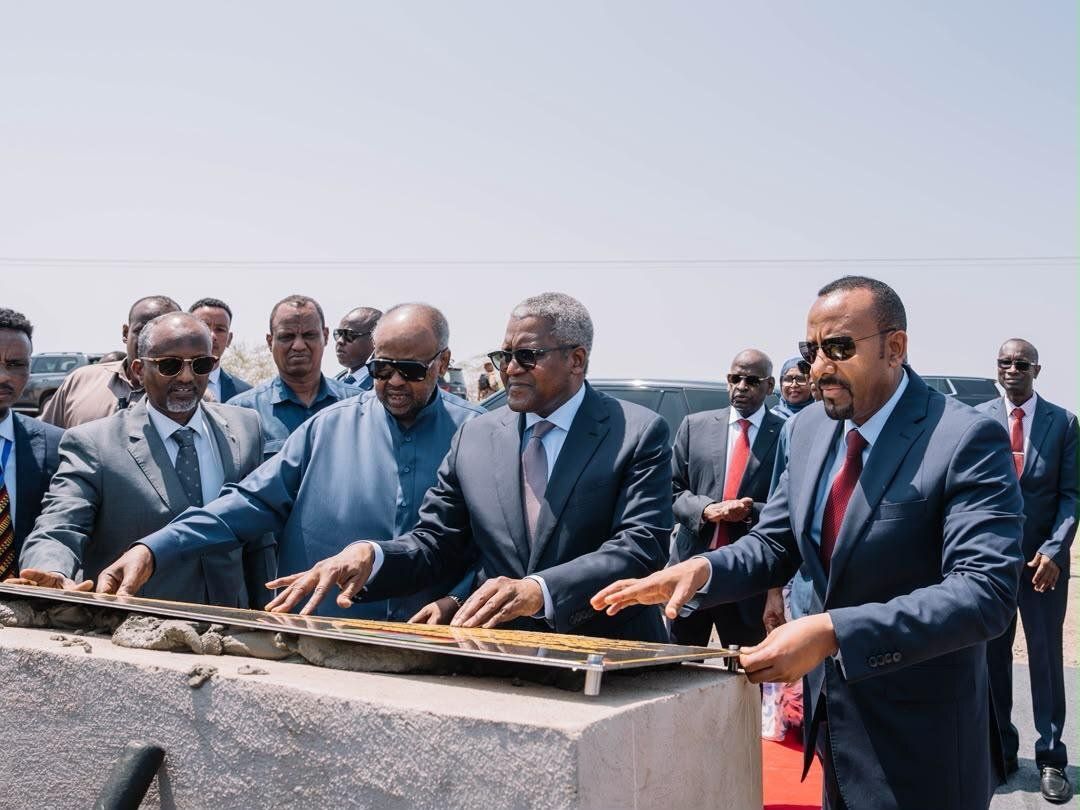
Djibouti, Ethiopia and Nigerian billionaire Aliko Dangote have broken ground on a major petroleum infrastructure project linking landlocked Ethiopia to the Red Sea.
The 120- kilometer pipeline will transport refined petroleum products from Damerjogon Djibouti’s coast, to Dewele on the Ethiopian border, connecting coastal storage facilities with inland storage and distribution infrastructure.
Djibouti President Ismaïl Omar Guelleh, Ethiopian Prime Minister Abiy Ahmed and Aliko Dangote attended Thursday’s ceremony at the Damerjog industrial park, where construction began on a petroleum storage terminal that will serve as the starting point for a 120-km multi-product pipeline to Dewele in eastern Ethiopia.
The project is being developed through a partnership between Ethiopian Investment Holdings and Dangote Group.
The first phase includes a modern storage terminal at Damerjog with capacity of 375,000 cubic metres and the ability to handle up to 5 million tonnes of petroleum products a year, according to Djibouti’s state news agency.
Long-standing delays
Prime Minister Abiy said the project was intended to address long-standing delays and inefficiencies along one of East Africa’s most important trade corridors.
“Every litre of fuel that reaches Addis Ababa today has spent five days on a truck,” Abiy said at the ceremony. “That is the challenge we have come here to solve.”
The new pipeline, he said, would reduce the journey to about one day, while increasing reserves and improving the reliability of supplies during periods of global disruption.
For Ethiopia, which relies heavily on Djibouti for access to international trade, the project is expected to reduce dependence on long-distance road transport of petroleum products and ease bottlenecks along the corridor.
Djibouti, meanwhile, is seeking to consolidate its role as a regional logistics and energy hub by increasing activity around its ports and energy infrastructure.
“The strength of this partnership lies in what each partner brings,” Abiy said, pointing to Djibouti’s strategic location and port infrastructure, Ethiopia’s large and growing market, and Dangote’s capital and industrial expertise.
“It is African capital building African infrastructure for African growth,” he said.
The project is intended to transport products including aviation fuel, automotive gas oil and premium motor spirit, according to Dangote.
‘Transformative project’
“This is not just a pipeline project,” Dangote said. “It is a transformative project that expands the economy and entrenches energy security in very volatile times.”
He said the infrastructure would support industries including manufacturing, aviation, agriculture, construction and transport, while creating jobs during construction and permanent technical and administrative positions once operations begin.
The investment comes as Djibouti and Ethiopia seek to deepen economic integration around a corridor that carries most of Ethiopia’s international trade.
Abiy said the existing system of ports, roads, railways, storage facilities and logistics centres needed to operate as a connected network if the corridor was to meet future demand.
“The port, the highway, the railway, the modern logistics centre, the storage terminals and the pipeline must work as one connected system,” he said.
“When they work together, journeys shorten, trade expands and the entire region becomes more competitive.”
Dangote said the group planned to invest $50 billion across Africa by 2030 under its Vision 2030 strategy. He also said Ethiopia was expected to become a fertilizer exporter by the beginning of 2029.
“We must move from potential to production,” Dangote said. “We must also move from dependence to self-reliance.”
He urged African governments and financial institutions to play a greater role in financing infrastructure on the continent.


Ethiopia's army says it has foiled attacks by Tigray rebels
The army said it inflicted heavy personnel and equipment losses on the TPLF rebels.
The cost of UNGA: Who pays and who profits?
Member states make mandatory annual contributions based on capacity to pay, factoring in gross national income, external debt burden and per-capita income.
Sudan rejects US remarks questioning government legitimacy amid Burhan visa dispute
Khartoum urges Washington to respect Sudan’s sovereignty as activists and journalists criticise the reported linking of Transitional Sovereignty Council Chairman Abdel Fattah al-Burhan’s UN visa to a proposed 90-day truce.