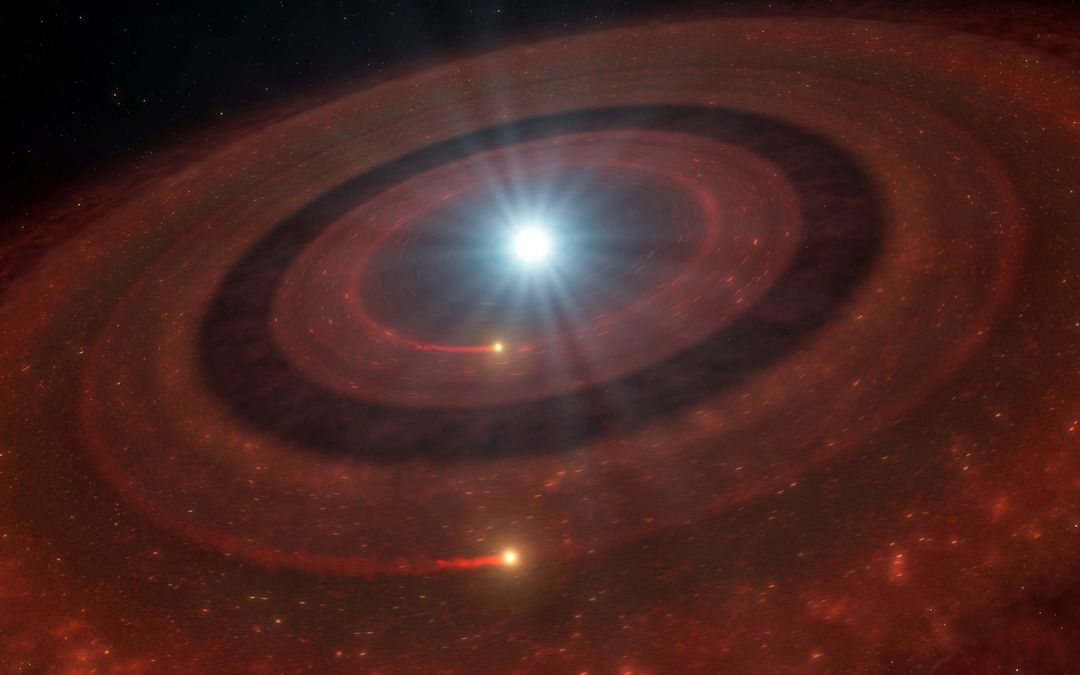
A white dwarf 1,600 light-years away is surrounded by two rings of planetary debris, suggesting some rocky bodies can survive when a star expands and sheds its outer layers.
Astronomers have discovered an unusual double-ring debris disc surrounding a white dwarf, offering a possible glimpse into the distant future of our solar system when the sun reaches the end of its life.
Billions of years from now, the sun is expected to run out of fuel and expand into a red giant before shedding its outer layers and leaving behind a dense core known as a white dwarf. Some planets may be destroyed in the process, while others could survive.
The newly observed white dwarf, named J1328−1450, is surrounded by two distinct rings of planetary debris. Researchers believe the structure may have been shaped by two rocky bodies that survived the star's violent transformation.
Located around 1,600 light-years from Earth in the constellation Virgo, the white dwarf was observed using the European Southern Observatory's Very Large Telescope in Chile.
Complex remnants
Before this discovery, astronomers had identified 21 white dwarfs with surrounding debris, but all had a single disc rather than the double-ring structure seen around J1328−1450.
The findings, published in the journal Nature Astronomy, suggest planetary systems can leave behind more complex remnants than previously thought.
“It shows that the remnants of a planetary system can have a much more complex structure than we previously thought, and provides further support to the idea that planetary rocky bodies may survive the transformation of a star into a white dwarf,” said astronomer Felipe Lagos-Vilches of Universidad Tecnica Federico Santa Maria in Chile, one of the study's authors.
A glimpse of the future
Lagos-Vilches said the star may originally have hosted a planetary system before expanding into a red giant, engulfing some of its innermost planets while more distant bodies survived.
“The planetary system did not completely disappear. Some surviving rocky bodies may have been gravitationally perturbed onto highly eccentric orbits that brought them close to the white dwarf,” he said.
In about five billion years, the sun is expected to enter its red giant phase, Lagos-Vilches said.
“Mercury and Venus are expected to be engulfed by the expanding sun, while there is still no clear consensus on whether Earth will also be engulfed during this phase,” he said.
Jupiter, Saturn, and more distant bodies are expected to have a better chance of surviving.
After the sun becomes a white dwarf, surviving planets, moons and asteroids could eventually be pulled close enough to be torn apart by its gravitational force.
“A debris disc like the one around J1328−1450 could therefore represent one possible stage in the very distant future of our own planetary system,” Lagos-Vilches said.
Authorities say the man said he heard voices telling him to kill the president after officers found him near the White House in a stolen vehicle with three different firearms in it.
The Foreign Ministry stresses that the process of obtaining the country's consent has not yet been completed for the portion of the planned activities falling within its continental shelf.