The coalition government faces its first major test as divisions over Russia, the EU and Kosovo threaten to complicate the country’s post-Vucic political transition.
Serbia’s new student-backed coalition brings together pro-European and Serbian nationalists, raising questions about the country's foreign policy after years of Aleksandar Vucic's balancing act between Russia, China and the West.
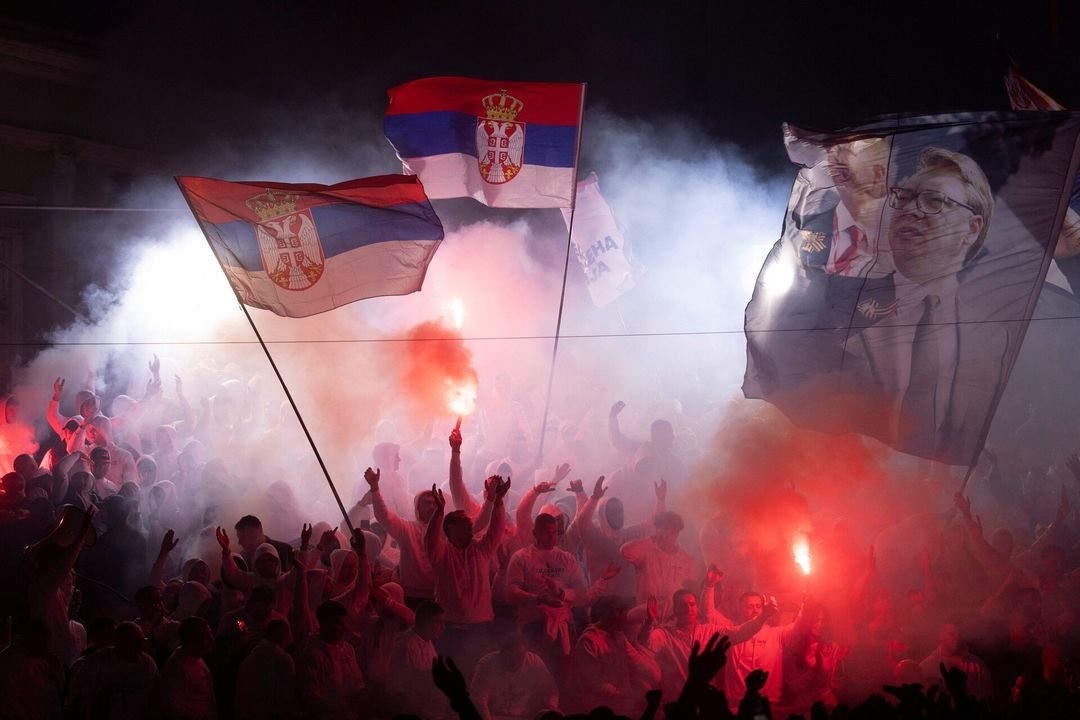
The Student List, which brought together farmers, actors, judges and academics, emerged after a concrete canopy collapsed at Novi Sad railway station on November 1, 2024, killing 16 people.
The disaster sparked demonstrations over alleged corruption and a lack of accountability, which gradually developed into a nationwide movement against Vucic.
Irfan Kaya Ulger, an international relations scholar at Kocaeli University, describes the Student List as “an organisation that cooperates solely on the basis of opposition to Vucic”.
“The coalition members come from diverse political and socioeconomic backgrounds. They do not share a common ideology or have a unifying, charismatic leader,” Ulger tells TRT World.
Their differences could complicate decisions on some of Serbia's most sensitive foreign-policy issues, including relations with Russia, China and the European Union, as well as the unresolved dispute over Kosovo, he says.
Under Vucic, Serbia pursued a four-pillar foreign policy aimed at maintaining relations with Moscow, Beijing, Brussels and Washington.
The Student List's election campaign, however, focused largely on domestic issues, particularly corruption and government accountability, offering little indication that the strategy will change.
When Vucic dissolved parliament in September, the movement turned its attention to the election. Volunteers travelled across Serbia under the slogan “One student for every village”, speaking with voters and mobilising support.
As a result of these efforts, voter turnout approached 70 percent—the highest level since 1992. In the elections held on October 25, the “Student List” managed to secure 141 seats in the 250-seat National Assembly of Serbia by surprisingly winning 53 percent of the vote.
The Student List's victory has now placed a movement built around demands for domestic political change in a position to shape Serbia's international relationships.
Balancing act?
The biggest foreign policy challenge facing the student-led coalition that ousted Vucic—who had extensive government experience—will undoubtedly be the ongoing war between Russia and Ukraine.
Since the start of the war, the Vucic administration has faced significant pressure from the West to impose sanctions on Russia and send weapons to Ukraine.
At the same time, Vucic has faced pressure from nationalist groups at home to adopt a pro-Russian foreign policy.
This is because Serbia’s future stance on the ongoing war between Moscow and Kiev has the potential to fundamentally reshape its foreign policy—from Belgrade’s identity- and energy-based relations with Russia, to its investment-based ties with China, to the defence cooperation it seeks to build with the United States, and to its European Union accession process.
However, the Student List includes both those who are even more hardline Serbian nationalists than Vucic and those who advocate for full integration with the European Union.
According to Ulger, it will be far from easy for people with such diverse ideologies to find common ground on policy.
The election results in Serbia were greeted with joy in the European Union. The issue of judicial and media independence—one of the new government’s campaign promises—appears poised to catalyse faster EU accession negotiations.
However, recognising Kosovo’s independence—a non-negotiable condition for EU membership—also shows that Serbia–EU relations will not progress so smoothly, Ulger says.
“Unlike Vucic, the new government will be forced to take a pro-EU stance. If it does so, it may face pressure from Serbian nationalists in domestic politics,” he says.
New government and regional stability
The new Serbian government's approach to Kosovo and Republika Srpska, the Serb-majority entity within Bosnia and Herzegovina, will also affect stability in the Balkans.
Although Student List candidates promised to pursue peaceful relations with neighbouring countries during the election campaign, questions remain over how the coalition will respond to demands from Serb communities beyond Serbia's borders.
Ulger raises a key question: “What will happen when the Serb minorities in Kosovo and Bosnia ask the new government for support?”
The issue could expose further divisions within the coalition, says Ulger, warning of “major challenges in the coming months”.
TRT World / Abdurrahman Yazici — TRT World