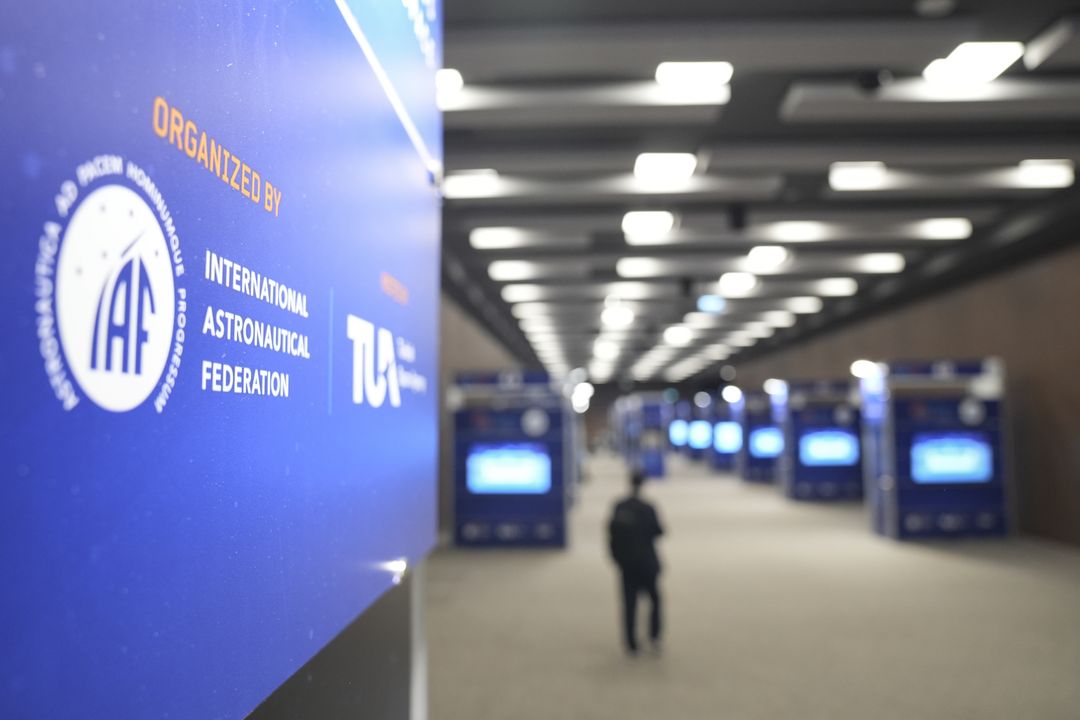
More than 10,000 delegates, heads of major space agencies expected in Antalya on October 5-9 for 77th International Astronautical Congress, 1st ever held in Türkiye.
Once a year, the world’s space community gathers to debate where humanity goes next beyond Earth.This year, the list is long: weapons in orbit, artificial intelligence data centres in space, overcrowded skies and a new race to the moon.Those issues top the agenda of the 77th International Astronautical Congress, or IAC, widely described as the largest international gathering of the space sector.
It will be held October 5-9 at the NEST Convention Center in Belek, near the Mediterranean resort city of Antalya.
It marks the first time Türkiye has hosted the congress since its launch in 1950.Organisers expect more than 10,000 registered participants, from space agency chiefs and company executives to engineers, scientists and students.
This year’s theme is “The World Needs More Space.”Here is a look at what will be discussed, who is coming and why the meeting matters.What is IAC?The congress is organised every year by the International Astronautical Federation, a nonprofit organisation founded in 1951 to connect space organisations across national borders.
The first such congress was held in Paris a year earlier, when spaceflight was still largely a dream.Today, theIACworks as a mix of scientific conference, trade fair and diplomatic summit.
Researchers present thousands of technical papers, companies show off rockets and satellites in a large exhibition hall, and leaders of several space powers share the same stage.The event has also served as a launch pad for big announcements.
At the 2016 congress in Guadalajara, Mexico, SpaceX founder Elon Musk first laid out his plan to build a giant rocket to carry people to Mars, the design that later became the company’s Starship.
A year later, in Adelaide, Australia used the congress to announce it would create its own national space agency.The host country changes every year, usually rotating among different continents.
Last year’s congress was held in Sydney, Australia.What’s on agenda?The official programme covers a wide range, from moon exploration to space medicine.One headline session is titled “Geopolitics vs.
Innovation,” another looks at how regional organisations govern space, and a third tackles what organisers call “orbital oversaturation.”The European Space Agency said it expects space security, exploration and the ethics of activities beyond Earth to be among the week’s themes.NASA plans to present results from its Artemis II mission and hold a news conference on the Artemis Accords, a set of US-led principles for peaceful exploration.
Its Jet Propulsion Laboratory will also present its work on “trusted AI on Mars,” with a session examining how an autonomous planning system has been used to operate the Perseverance rover and how such technology could support future missions searching for life beyond Earth.The harder questions sit just outside the programme’s titles.On September 14, US Air Force Secretary Troy Meink said the US Space Force already has weapons in orbit designed for “space control,” without saying what they are.
It was a rare public admission that a country has operational weapons in space.Washington is also building Golden Dome, a missile shield backed by President Donald Trump that would include interceptors stationed in orbit.
Officials say it could be operational by the summer of 2028, and the White House first estimated its cost at $175 billion.Critics say orbiting interceptors could double as satellite killers and push rivals to build more anti-satellite weapons of their own.
Russia and China have both tested anti-satellite weapons.The 1967 Outer Space Treaty, the founding law of space, bans nuclear weapons in orbit but says little about conventional arms.Artificial intelligence is the other new pressure.In January, SpaceX asked US regulators for permission to launch up to 1 million satellites that would work as data centres in orbit.
Google is sending its own AI chips into space for testing this week under a project called Suncatcher.Supporters say orbit offers steady solar power for energy-hungry AI.
Skeptics point to high costs, radiation damage and the risk of adding still more hardware to increasingly crowded orbits, where debris from a single collision can threaten other satellites.A separate lecture at the congress will look at the safety of giant satellite networks from the viewpoint of Starlink, SpaceX’s internet constellation.
Michael Nicolls, SpaceX’s senior vice president of Starlink engineering and president of SpaceXAI, will discuss the safety and sustainability challenges involved in operating a constellation on that scale.Who is coming?The Global Space Leaders Summit on October 6 will bring together heads and senior officials from space agencies and offices from more than 40 countries.NASA’s delegation will be led by Deputy Administrator Matt Anderson.
European Space Agency Director General Josef Aschbacher will also attend, along with India’s ISRO Chairman V.
Narayanan, China’s CNSA Chief Engineer Li Guoping, JAXA President Hiroshi Yamakawa and Canadian Space Agency Acting President Jean-Claude Piedboeuf.The summit will also bring together space officials from countries including the United Arab Emirates, Brazil, Spain, the UK, France, Germany, South Korea, Pakistan, South Africa and Poland.Aarti Holla-Maini, director of the UN Office for Outer Space Affairs, is also set to attend the congress.The congress will also feature more than 25 astronauts, along with ministers and aerospace executives.Jonathan Cirtain, CEO and president of Axiom Space, and Mike Gold, president of Redwire, are among the industry executives attending.
Other prominent industry figures include Awais Ahmed, founder and CEO of Indian space company Pixxel, and Murat Ikinci, CEO of Turkish defence and aerospace company Roketsan.The event is coordinated by Türkiye’s Ministry of Industry and Technology, hosted by the Turkish Space Agency (TUA) and co-hosted by SAHA Istanbul, a defence and aerospace industry cluster, with Anadolu as its global communications partner.