Türkiye's Emine Erdogan leads first ladies’ call for UN framework to protect children online
Source:
TRT World


With minors increasingly exposed to online exploitation, harmful content and AI-driven risks, First Lady Emine Erdogan calls for global standards for child safety, as world leaders’ spouses urge stronger protections in the digital world.
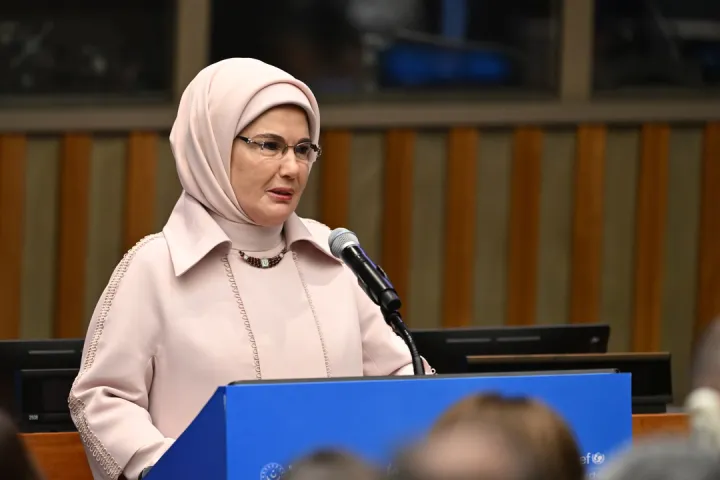
As technology companies expand their influence over children's lives, first ladies and spouses of world leaders have called for a common international framework to protect young users, with Türkiye's Emine Erdoganurgingthe United Nations to establish shared standards for digital safety.Speaking at a high-level meeting at UN headquarters in New York on September 21, Erdogan said national regulations alone could not adequately address the challenges posed by global technology companies and called instead for coordinated international action.The event, titled “The Invisible Architecture: Building Safe Digital Systems for Children”, was held on the sidelines of the 81st United Nations General Assembly high-level week under Erdogan's auspices, in cooperation with UNICEF and the Office of the UN Special Representative of the Secretary-General on Violence against Children.The discussion brought together first ladies and spouses of heads of state and government from 13 countries, who highlighted the growing risks children face online and the need to make their safety a shared international responsibility.From national restrictions to global standardsErdogan cautioned against treating technology as an outright threat, but argued that digital platforms had evolved far beyond communication tools into systems that can direct societies and reshape everyday life.“We cannot be a mere onlooker to technology, which we have invented ourselves, inventing a new human type that will serve its purposes in front of our own eyes,” she said.She criticised business models that prioritise profit and engagement over children's well-being, arguing that the pressure exerted by such systems on young users must be addressed.“Ensuring children's safety is not solely the responsibility of parents; it is the responsibility of all of us.
We must build a healthy digital ecosystem and ensure that safety is not an additional feature added to digital systems later, but the starting point of their design,” she said.Türkiye, she noted, introduced legal and technical measures on children's social media use early on.
However, individual national regulations can make standardisation difficult when companies operate globally.“Therefore, we should unite our common efforts,” Erdogan said, calling for common global standards under the UN, supported by regular monitoring and reporting mechanisms.Her proposal found support among other speakers, who similarly argued that the cross-border nature of digital platforms requires a response beyond national legislation.Lebanese Prime Minister's spouse Sahar Salam backed a common international framework to establish minimum standards for child safety, clear responsibilities for technology companies, and effective cross-border cooperation.“No country can protect its children in the digital world alone.
Technology crosses borders instantly.
Our protection systems do not,” she said.Romanian First Lady Mirabela Gradinaru also compared it to road safety, noting that countries have their own rules and enforcement mechanisms, while the internet has no equivalent boundaries.“The problem is no longer local; therefore, the solution can no longer be only local,” she said.The risks children face behind the screenBeyond regulation, the speeches highlighted how digital environments expose children to exploitation, manipulation, cyberbullying, harmful content and violations of privacy.Queen Mathilde of Belgium centred her remarks on children’s rights, arguing that children cannot be treated as a variable in technology companies’ business models.“We have a collective responsibility to act to safeguard children's rights, safety and wellbeing,” she said.Burundian First Lady Angeline Ndayishimiye acknowledged the opportunities digital technologies offer young people, particularly across Africa, while warning that these benefits come with growing risks to children's safety and dignity.Kenyan First Lady Rachel Ruto described the internet as a shared digital space in which threats do not respect national borders.“A child's data, image, location, and online behaviour are not commodities to be harvested; they are part of that child's dignity, rights, and future,” she said.The discussion also extended beyond social media to artificial intelligence, with Canadian Prime Minister's spouse Diana Fox Carney warning that AI represents the next frontier in child protection.“Our children should not have to surrender their childhood to the technologies that we create,” she said.Serbian First Lady Tamara Vucic called for children to be equipped with the knowledge to understand AI, alongside safe standards for its use in education and stronger international cooperation.Lithuanian First Lady Diana Nausediene, meanwhile, urged countries to explore technological solutions that could enable effective age verification while protecting personal data against leaks, tracking and profiling.Making child safety a shared responsibilitySeveral speakers stressed that international standards must be accompanied by clear obligations for technology companies and practical support for families, schools and communities.Guatemalan First Lady Lucrecia Eugenia Peinado Villanueva called on companies to put children's rights and safety at the centre of their operations, while urging governments to establish and enforce clear standards.She also emphasised that children themselves must have a voice in decisions affecting their digital lives.Gambian First Lady Fatoumatta Bah Barrow argued that technological progress should be measured not simply by innovation, but by whether children can benefit from it safely.“Years from now, the most important question will not be how clever our technology becomes.
It will be whether our children were able to experience its promises safely,” she said.Senegalese First Lady Marie Khone Faye also called on spouses of world leaders to use their public platforms to mobilise support and translate commitments into action.For Sierra Leonean First Lady Fatima Maada Bio, the guiding principle should be that technological advancement strengthens rather than diminishes children's rights and well-being.The speeches converged on a central message: protecting children in an increasingly connected world requires more than regulating their access to technology.It demands accountability from the companies designing digital environments, cooperation between governments and recognition of children as rights holders whose safety must take precedence over commercial interests.







G20 ministers gather in US as tariff standoff deepens
Canada and the European Union push to strengthen trade ties beyond the US as tariff tensions with Washington intensify.
Tennessee set to execute first woman in over 200 years
Christa Pike, 50, faces lethal injection for a murder committed at 18 after the governor rejected a clemency plea citing childhood abuse and mental illness.
Dangote set for construction of $16 billion refinery in Kenya
The project, however, faces criticism from environmental campaigners who fear it could affect a World Heritage site that hosts fragile marine ecosystems.





All rights reserved. Newstimetr © 2026