"Ankara is ready to pursue joint projects with Riyadh, citing a portfolio of around $120 billion and more than 1,400 projects," a top defence official Haluk Gorgun says.
Türkiye is ready to expand defence industry cooperation with Saudi Arabia, backed by over 1,400 projects and a $120 billion portfolio, the country's top defence official has said.
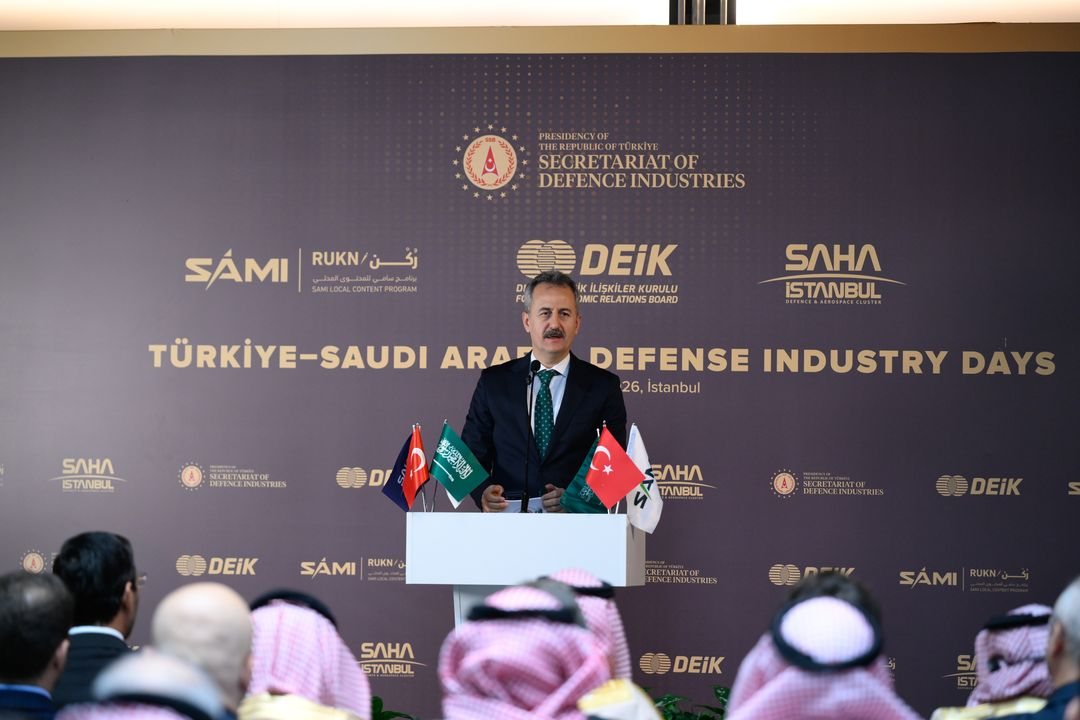
The head of Secretariat of Defense Industries (SSB), Haluk Gorgun, spoke on Thursday at the Türkiye-Saudi Arabia Defence Industry Days in Istanbul, organised by Türkiye's Foreign Economic Relations Board (DEIK), defence industry cluster SAHA Istanbul, and Saudi Arabian Military Industries (SAMI).
Saudi Minister of State and Acting Governor of the General Authority for Military Industries (GAMI) Bandar Al-Khorayef, Türkiye's Deputy Industry and Technology Minister Cetin Ali Donmez, and Istanbul Governor Davut Gul also attended.
"With our nearly 4,500 defence SMEs, over 1,400 projects, a roughly $120 billion portfolio, and our president's mandate, we are ready to take every step we can to develop together," Gorgun said.
Gorgun noted that Türkiye has built a strong defence ecosystem over the past 20 years under President Recep Tayyip Erdogan and aims to co-develop its model with friendly nations.
He said Turkish officials held 75 meetings over the past 3.5 years with Saudi counterparts, including GAMI, SAMI, and the General Authority for Defence Development (GADD).
Gorgun added that Turkish companies are conducting joint work with Saudi partners to support Riyadh's Vision 2030 goal of localising at least 50 percent of defence production.
He also noted that leading Turkish firms and Saudi officials have held meetings on prioritising and establishing defence centres of excellence under Vision 2030.
Al-Khorayef said Türkiye and Saudi Arabia cooperate not only in industry, but also on the basis of brotherhood, highlighting joint efforts in the G20 and the Makkah Agreement.
He said Saudi Arabia's defence localisation rate rose from 4 percent to 27 percent, with a target of reaching 50% under Vision 2030 through technology transfer and long-term partnerships.
The Saudi minister noted that Riyadh offers incentives to attract investors and build a globally competitive defence industry powered by international research and development experience.
Deputy Industry and Technology Minister Cetin Ali Donmez said Türkiye's annual exports have approached $300 billion, with manufacturing accounting for roughly $260 billion of that total.
Since the pandemic, the country's high-technology exports have grown by 87.5 percent, and the share of high- and medium-high-technology products in overall exports has reached 44.2 percent, Donmez said.
Donmez noted that Türkiye's total R&D expenditure reached $24.8 billion, surpassing 1.5 percent of national income, supported by an ecosystem of 318,000 R&D personnel.
He highlighted that Türkiye's defence and aerospace exports surged from $248 million in 2002 to over $10 billion today, employing more than 100,000 skilled personnel across over 4,000 entities.
Donmez added that the ministry issued over 1,200 investment incentive certificates for the sector, while 80 defence R&D centres received 71 billion Turkish liras in state support last year.
He also noted that the Scientific and Technological Research Council of Türkiye (Tubitak) provided 65 billion liras in support to over 2,200 defence projects and more than 4,000 researchers.
Istanbul Governor Davut Gul emphasised that Istanbul serves as a major global trade hub where business representatives from around the world meet weekly.
Gul noted that SAHA Istanbul has elevated defence industry clustering, transferring Türkiye's accumulated expertise to both domestic organisations and international stakeholders.
SAHA Istanbul Vice Chairman and Roketsan CEO Murat Ikinci said bilateral defence cooperation will significantly contribute to both countries' industrialisation and technological deepening goals.
He noted that the joint will demonstrated through the Makkah Agreement has paved the way for concrete projects, backed by strong political motivation for co-production and technology transfer.
Ikinci stressed that cooperation should include SMEs, subcontractors, and tech startups, noting that SAHA Istanbul represents Europe's largest technology cluster with over 1,300 member firms.
He added that joint R&D in autonomous systems, integrated air and missile defence, propulsion technologies, and space systems will offer both nations rapid results.
TRT World / َAA — TRT World / َAA
Photo: َAA