A criminal investigation, mounting financial disputes and repeated delays are raising questions over the viability of an EU-backed Eastern Mediterranean energy project designed to sideline Türkiye.
For years, Greece and the Greek Cypriot administration have presented the Great Sea Interconnector (GSI), a power cable meant to link Crete to Cyprus and later Israel, as the Eastern Mediterranean’s strategic energy project.
Brussels, too, laid the institutional groundwork by granting “Project of Common Interest” status to a project conceived as part of an energy architecture that sidelines Türkiye.
Yet the record of a project with an estimated cost of 1.9 billion euros does not match this ambitious rhetoric.
Even the seabed surveys for the cable, whose timetable has slipped time and again, could only resume in mid-November 2026 after being left half-finished in July 2024.
This deadlock on the ground is now compounded by a criminal investigation.
The investigation into the project by the European Public Prosecutor’s Office (EPPO), the prosecutor of the very EU whose door Athens and the Greek Cypriot administration often knock on to complain about Türkiye, became public in September 2025, and no closure has been announced since.
It was the Greek Cypriot administration’s own Audit Office that had sounded the alarm before the investigation. In December 2024, the office had warned EU authorities about “potentially suspicious financial dealings” in the project and had contacted the prosecutors.
A Greek Cypriot newspaper also reported that the prosecutors were investigating how a proposal by an individual lacking both technical expertise and external financing first won a loan of 100 million euros from the Greek Cypriot administration and then the backing of Brussels.
The fact that the suspicions were raised by the Greek Cypriot Audit Office itself refutes, through the partners’ own institutions, the narrative that pins every setback in the project on Türkiye.
This narrative, sustained by the strategic priority label from Brussels, had for years given the GSI a de facto strategic immunity, and the EPPO investigation pierced that immunity for the first time.
The two partners, long in the habit of presenting Türkiye’s legal objections as a “threat”, now have to answer for a project that the EU’s prosecutor has put under the microscope.
Immunity under scrutiny
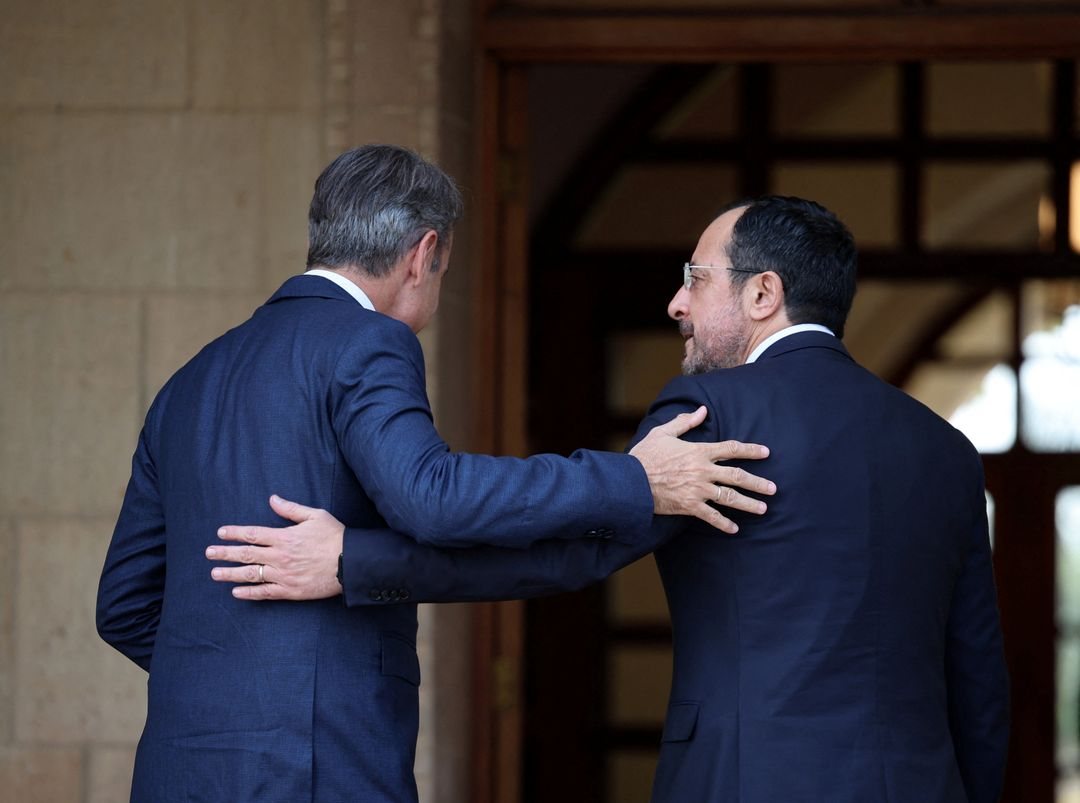
Greek Cypriot leader Nikos Christodoulides was the first to announce publicly, on 3 September 2025, that the investigation concerned “possible criminal offences”.
The EPPO, which deals with crimes against the EU’s financial interests, contented itself with confirming the existence of the investigation the following day.
That news of a criminal probe involving EU funds came from the Greek Cypriot leader before it came from Brussels shows that the Union has left even the duty of informing the public to its partners’ discretion.
In January 2022, the Union allocated the largest share of a cross-border energy infrastructure package, 657 million euros, to EuroAsia Interconnector, the Greek Cypriot company then running the project.
Brussels, which set aside this share for a project whose viability is still debated, pushed financial discipline into the background for the sake of a corridor that excludes Türkiye.
EuroAsia, the recipient of the grant, announced in October 2023 that it was handing over the “baton” as it transferred the role of project promoter to Greece’s Independent Power Transmission Operator (IPTO).
Yet along with the baton, the questions over the project’s financial past also passed into Athens’ area of responsibility.
A Greek Cypriot television channel reported that 48.8 million euros paid into EuroAsia’s account during the handover returned to IPTO within days and that this strange transaction was also on the prosecutors’ radar.
Around the same time, a Greek Cypriot newspaper, citing sources, also wrote that the prosecutors were examining a Commission employee who had taken part in the approval process for EuroAsia’s applications and was later found to have worked for the company.
For his part, Piotr Serafin, the EU commissioner responsible for budget and anti-fraud, said, when the investigation was confirmed, that he was not aware of any concern raised by his office about the project.
However, as early as August 2023, the Greek Cypriot Audit Office had raised the very question the prosecutors are now pursuing, reporting to the Commission a lack of transparency over how a private investor had managed to take on a strategic project.
That the Commission learned of suspicions over a grant of this size from a Greek Cypriot institution points either to serious weakness in fund management or to Brussels’ knack for not seeing what does not suit it.
Athens, too, chose to pass questions about the investigation on to its partner instead of answering them. Greek government spokesman Pavlos Marinakis said Athens had not yet received any notification from the European Public Prosecutor’s Office and would seek information from the Greek Cypriot administration.
In a project whose promoter is a Greek company, waiting for the partner’s explanation is nothing more than an attempt by Athens to postpone its own share of the reckoning.
Who foots the bill?
The EU grant covers roughly a third of the total cost, which leaves a heavy burden still to be shouldered in a project overshadowed by the investigation.
The Greek Cypriot administration took on part of this burden and agreed to pay IPTO 25 million euros a year to cover project expenditure.
To pay this money out of public funds instead of recovering it through electricity tariffs is to hand Greek Cypriot taxpayers the bill for a line that has yet to enter service.
It was from within the Greek Cypriot administration itself that the fiercest objection to the decision came. Finance Minister Makis Keravnos, citing two separate studies, argued that the project was “not sustainable” and found it absurd to make payments for an “essentially frozen” project.
Greek Energy Minister Stavros Papastavrou said Keravnos was relying on “two studies which he does not show” and criticised the “constantly conflicting messages” coming from the Greek Cypriot side. In Papastavrou’s words, the project was “stuck in a constant questioning of its viability”.
Also in dispute was the amount of expenditure on which the payment rested. In July 2025, the Greek Cypriot energy regulator verified 82 million euros of IPTO’s expenditure, while IPTO disputed the figure and claimed to have spent 251 million euros.
Accusations levelled at Ankara by partners who do not even trust each other’s figures serve to cover up this internal settling of scores.
This mistrust became tangible in October this year, when Polis Lemonaris, head of the Greek Cypriot energy regulator, found the cost estimate of 1.9 billion euros unrealistic and predicted another year of delay.
In August, the French firm Meridiam’s takeover of a majority stake in the project also left unanswered the question of who bears the cost.
The Greek Cypriot Treasury had insisted on classifying the GSI as a fiscal risk for 2026-2028. In October 2025, Greek Cypriot MP Irini Charalambides also warned of a “fiscal nuclear bomb” stemming from the LNG terminal at Vasilikos and the GSI, whose final cost no one knows.
In July 2024, the European Public Prosecutor’s Office had also announced an investigation into the Vasilikos terminal on suspicion of “procurement fraud, misappropriation of EU funds and corruption”.
In September 2025, Brussels demanded the return of 67.2 million euros of its funding for this project over possible irregularities in the tender, and the Greek Cypriot administration had to pay the money back.
These two cases, which reached the prosecutors after warnings from the Greek Cypriot Audit Office, lay bare how the Greek Cypriot administration, for all its claim to be the region’s energy hub, struggles even to account for the EU funds it receives.
Commission energy spokesperson Anna-Kaisa Itkonen, meanwhile, had stressed, around the time the GSI investigation was confirmed, that the project was of “utmost political and strategic importance” and had declined to comment on the probe.
The fact that Brussels, never slow to lecture Türkiye in its annual reports, acts as both financier and advocate of the same project stands out as a fresh case of double standards, especially given Greece’s record with EU funds.
A NAVTEX smokescreen
The navigational warnings issued by Greece and the Greek Cypriot administration on November 6 for seabed surveys by the French-flagged vessel Abeille Marengo cannot be seen in isolation from the EPPO investigation either.
This step, taken while the final cost is still unknown, reflects an effort to create an appearance of progress on the ground and to mend, with sovereignty rhetoric, the strategic immunity shaken by suspicion of corruption.
Greek Cypriot leader Christodoulides’ move in September to tie the first instalment of 25 million euros to the issuing of the NAVTEX under his agreement with the Greek prime minister also reveals that the navigational warning was a payment condition between the partners.
Although the condition had been met, Greek Cypriot administration spokesman Konstantinos Letymbiotis announced, 11 days after the warning, that the process for the payment had only just been launched.
What remained of the surveys that had become a condition for the payment was to be carried out in the area between Kasos and Cyprus.
Türkiye’s Ministry of National Defence had stated as early as September that cable-laying and scientific research in this area without prior coordination with Ankara were not permitted, yet Athens and the Greek Cypriot administration ignored the statement.
Ankara, for its part, cancelled these “unauthorised” warnings, and the Foreign Ministry stressed that the activity was intended to take place on the Turkish continental shelf, whose outer limits were submitted to the UN on 18 March 2020, and that work there required Türkiye’s consent under the established rules of international law of the sea.
Although Türkiye gave its consent to the surveys following diplomatic contacts with Paris, Athens insists that permission was sought only from Greece and the Greek Cypriot administration.
However, Greek government spokesman Marinakis was forced to confirm that France, the vessel’s flag state, had notified Ankara of the survey through an official note, even as he rejected the view that the note tacitly recognised Türkiye’s position.
Marinakis dismissed the note, whose text he admitted he had not seen, as “the mildest form of communication between states”, yet this cannot hide the fact that even Athens’ ally Paris has treated Ankara as an interlocutor.
Subsequently, the Turkish NAVTEX issued on November 10 announced that, with Türkiye’s consent, the research would be conducted “along two specified lines within the Turkish navtex service area and the Turkish continental shelf”.
Ankara thereby put on record that the part of the research on its continental shelf was an activity conducted within Türkiye’s jurisdiction.
Athens tried to play down the announcement, yet it felt the need to declare the Turkish NAVTEX “null and void” with a counter-NAVTEX it issued straight away.
At sea, the consent supposedly declared void from behind a desk found its voice in the frigate TCG Gokova.
On November 12, the frigate, shadowing the vessel from a distance, reminded the Abeille Marengo by radio that it was on the Turkish continental shelf and was proceeding with Türkiye’s consent.
The Israeli leg of the project also remains on paper. Until the Crete-Cyprus line, caught between the EPPO investigation and the financing crisis, is completed, the energy leg of the axis formed by Greece, the Greek Cypriot administration and Israel is doomed to remain a declaration of intent.
A lasting energy link in the Eastern Mediterranean is possible only through the cooperation, dialogue and coordination that Ankara has emphasised, and on a basis that respects Türkiye’s sovereign rights over its continental shelf and the equal rights of Turkish Cypriots.
For now, however, what hangs over the project marketed as the region’s energy bridge is suspicion of corruption.
TRT World / Zeynep Gizem Ozpinar — TRT World
Photo: Reuters (Wire)