The journey to discovery began in 2008 when conservationists working in Lomami National Park photographed an unfamiliar monkey hidden among dense vegetation.
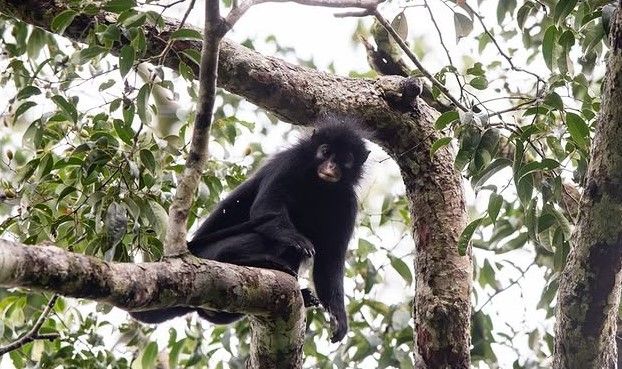
Deep in the rainforests of the Democratic Republic of the Congo, a group of glossy black monkeys watches silently from the forest canopy. Their distinct orange lips stand out against their dark faces as they peer cautiously through the leaves.
For years, they remained a mystery.
Now, scientists have confirmed the primate is a previously unknown species, a discovery that highlights the crucial role of African-led conservation research.
"We report the discovery of a new species of African primate from the eastern basin of the Lomami River and adjacent basin of the Upper Congo (Lualaba) River, Democratic Republic of Congo (DRC)," the research team wrote in a study published in the multidisciplinary scientific literature hub PLOS ONE.
The journey to discovery began in 2008 when conservationists working in Lomami National Park photographed an unfamiliar monkey hidden among dense vegetation. The images were too obscured for identification.
A decade later, another sighting reignited curiosity.
Determined to solve the mystery, Congolese researcher Junior Amboko, working with an international team, launched extensive field surveys across the forests between 2018 and 2022.
Conservationists have praised the discovery as representing more than just another name addition in Africa's wildlife catalogue.
"First and foremost, this finding shows that the local environment is healthy and actively supporting wildlife," Stephen Haruna, a Nigerian wildlife conservationist, tells TRT Afrika.
"Conservation should not only be about protecting species we already know exist. It should also include active exploration that discovers new species and new ways of protecting them. Every new discovery gives us deeper ecological insights that help us better support wildlife populations and improve their long-term survival," he said.
The discovery makes Colobus congoensis only the fifth new monkey species to be described in Africa in the last 75 years.
The team documented 114 sightings across an estimated range of about 1,700 square kilometres. The monkeys were found mainly in mature, closed-canopy forests growing on deep clay soils, where they live alongside two other colobus species.
To confirm the animal's identity, researchers combined field observations with DNA sequencing from biological samples, while comparing skulls, teeth, pelts and genetic records from museum collections. The evidence confirmed they had documented an entirely new species.
Haruna argues that scientific research itself is one of conservation's most powerful tools.
"Species are not threatened by hunting alone," he said. "They are also threatened when there isn't enough research to guide how we protect them."
He notes that many African countries still lack dedicated wildlife research institutions capable of training scientists and generating the ecological knowledge needed to safeguard biodiversity.
The Congo Basin, the world's second-largest tropical rainforest after the Amazon, is home to thousands of plant and animal species, many of which remain poorly studied because of the region's remoteness.
The discovery is being celebrated as a milestone for African science.
Although supported through international collaboration, the research was led by African scientists working in their own ecosystems.
"This study shows the quality of African scientific talent, which is too often underestimated," Haruna told TRT Afrika.
He believes the breakthrough should encourage governments across the continent to invest more heavily in local researchers rather than relying predominantly on foreign institutions to fund biodiversity studies.
"Many African researchers still depend largely on funding from institutions abroad. Governments need to do more to support homegrown scientists by providing grants that allow them to carry out this kind of important work," Haruna said.


Ethiopia's army says it has foiled attacks by Tigray rebels
The army said it inflicted heavy personnel and equipment losses on the TPLF rebels.
The cost of UNGA: Who pays and who profits?
Member states make mandatory annual contributions based on capacity to pay, factoring in gross national income, external debt burden and per-capita income.
Sudan rejects US remarks questioning government legitimacy amid Burhan visa dispute
Khartoum urges Washington to respect Sudan’s sovereignty as activists and journalists criticise the reported linking of Transitional Sovereignty Council Chairman Abdel Fattah al-Burhan’s UN visa to a proposed 90-day truce.